Wednesday, 6 December 2017

Christine Huvos on stage at the Zurich Volkshaus

La Vie en Rose – the night Christine Huvos lived it

Thursday 30 November 2017


This was the evening that Christine Huvos Federspiel always hoped she’d celebrate – an occasion to sing on stage some of her favourite chansons and standards in front of an audience of her friends and members of the public. Thanks to her husband, the well-known Zurich GP Dr. Urs Federspiel, on Thursday 30 November 2017 she was at last able to realise her ambition – and in what style! In a collaboration with the Pepe Lienhard Big Band and to the benefit of the hospital support charity Lebensfreude, Christine took to the stage of the famous Zurich Volkshaus to sing many of her favourite songs on the occasion of her 60th birthday. And thanks to advice from Pepe and support from a dedicated group of backstage workers, on a very snowy night she succeeded in raising the roof.

Stylish songstress


The program consisted of big band standards and swing numbers from the 18-strong Pepe Lienhard outfit interspersed with vocal classics in the style of Hollywood, Piaf and Christine’s own inimitable style. Thanks to help from her dresser and stylist Susann Melzer, Christine graced the stage in three glittery dresses in gold, red and black, together with a number of suitable props. Her voice was on strong form tonight as she managed to avoid all the seasonal coughs and colds plaguing some audience members. She never put a foot, or a note, wrong. And Christine’s formidable language skills once again stood her in good stead as she performed Mack the Knife, Petite Fleur and Big Spender with equal grace and ease. The Zurich-based band accompanied Christine with appropriately subtle and supportive brass sounds, enhanced by solos on clarinet, saxophone and piano.

Master of ceremonies Röbi Koller ensured that the program ran smoothly, and he also quizzed our favourite diva about her background – how did she come to be at ease in so many languages? She explained that she was born in the US, grew up in Vienna, studied in America and in Paris, and taught in international schools before settling down to enjoy her life in Zurich. She could also have mentioned that for fifteen or more years she has been a leading light in ZIWA, the Zurich International Women’s Association, where she founded the On Stage group, and now runs a French Conversation group as well as participating in many other social activities.

Wonderful big band


How the collaboration with Pepe Lienhard for this event came about is unclear – maybe the wives know something -, but the band certainly acquitted themselves wonderfully on this iconic stage, where Lenin once spoke. They opened the show with a Count Basie number, The Heat is On, followed up by I’ll Never Smile Again. Surely not true? In between vocal sets, they performed such classics as Moonlight Serenade and In the Mood (remember the Glen Miller Story?), Moanin’ featuring a trumpet solo, and Sing, Sing, Sing showcasing the drums, and ending on an optimistic note with the World War II classic, We’ll Meet Again.  We also witnessed a brief but touching moment when Christine’s husband Urs came on stage for a dance with his talented wife; I’m sure that didn’t go unnoticed by the many of his patients in the audience.

Great support team


In order to achieve this seamless performance, Christine owes thanks to a number of people: her dresser Susann Melzer from MODISSA, dramatic advisor Isabelle Gutleben, stylists Claudine Gablinger, Bettina Psora and Philippe Diaz, photographer Niklaus Stauss, film-maker and long-time collaborator Eugen Schwyn, lighting operator Simon Blum, Mary-Jane Parlett from the Arthur Murray Dance School and her brother Giuseppi Parlett, and practice assistants Andrea Baumann and Melanie Nef. Not to forget rehearsal accompanist Csilla Varga, and, very importantly, music arranger Carlo Schöb.


And with the eventual proceeds from the sale of CDs, ticket sales, and any DVDs going to local hospital charity Stiftung Lebensfreude, I’m quite sure that the evening turned out to be everything that Christine had hoped for and more! She can finally say with conviction ‘Non, je ne regrette rien’.


Julia Newton. 8 December 2017.

Friday, 30 June 2017

Chur rediscovered – Switzerland’s oldest city showing signs of change

Wednesday 14 June 2017

Several people on yesterday’s visit by ZIWA's Discovering Zurich and Switzerland group who had also been there with the group in 2009 noticed that the train station has been modernised since then. Outside the station we met our guide Caroline Lampert, who pointed out a modern artwork based on lotus flowers, which was certainly a surprise. And we were pleased that many of the streets around the old city have been pedestrianised, making our walking tour much easier. However, as we left Zurich in sun and arrived in Chur in rain, several ladies dived into the local shops to buy umbrellas.

Chur is Graubunden’s largest city where three languages are spoken – Rhaeto-Romansch, Italian and German. It’s also Switzerland’s oldest city, dating back to the fifteenth Century BC, with Bronze Age and Roman remains having been found here. The location at the junction of the Rhaetian railway with the northern route from the Bodensee to the Gotthard is also significant. We were surprised to learn that the Rhaetische Bahn owes its existence to the efforts in 1888 of a Dutchman, Willem Jan Holsboer, whose wife sought treatment in the Alpine resorts for TB.

Since our last visit, Chur has also gained a new extension to the Bundner Kunstmuseum, an art museum now covering three floors and two adjoining buildings. It contains works by local artist Angelica Kauffmann as well as Swiss artists Alberto Giacometti and Giovanni Segantini. In the Town Hall or Rathaus we saw a model of the city dated 1835. In the 17th century the old walls came through the central city area along Grabenstrasse, and three towers dating back then are still standing.  Fire ravaged the city in 1492 and the city was gradually rebuilt. The River Plessur runs through Chur into the Rhine, and mills grew up to process local produce.

Chur also has religious significance as a bishopric and seminary; the first bishop, Asinio, took office here in 451, the first north of the Alps. Wine growing is also important to the region as the centre of the Bundner Herrschaft wine region. For several reasons, the city was a focal point for travellers from southern Germany who made it an overnight stop. But Chur was late to accept the presence of motor vehicles and voted 25 years after other cantons to welcome the car instead of horse-drawn vehicles as late as 1925.


After seeing inside the Kunstmuseum and the Rathaus, we made our way through old cobbled streets past St. Martin’s Church with its large clock face, up to the Bishop’s Palace and Cathedral, noting the architectural styles on the way. The cathedral features Romanesque, Gothic and Biedermeier styles, the latter exemplified in the tower which was rebuilt after a fire in 1811. Inside we were impressed by the 15th century altarpiece triptych, designed by a German artist in 1486-92 and featuring gilded figures. We also noticed that the apse of the cathedral is crooked, although the reason is unclear. The church also contains the remains of a mural dating back to 1340 featuring an unconscious Mary, and a modern organ, praised for its clear sound. The Roman well provided water for travellers within the sanctuary of the building.


Around the city, we noted the tall houses which used pulleys to raise up water supplies, and the streets featuring the names of old families such as the Hegisplatz. After this enlightening tour, we were more than ready to dive into the ‘Drei Bünden’ or Three Guilds restaurant for a pre-arranged lunch and time to chat with new friends. Thanks to Rowena Woollard for another great day out.


Julia Newton, 15 June 2017.

Monday, 21 November 2016

Beyer Clock Museum - and Diamonds

See also:
http://www.beyer-ch.com/en/museum/portrait-museum.html


On Wednesday 16 November, another large group of ZIWA's Swinging Sixties met at Paradeplatz in Zurich to go on a tour of discovery of the nearby Beyer Clock Museum. There are signs to the museum all down the famous Bahnhofstrasse, but how many people had been inside the store made prominent by the enormous pocket watch outside? Once again, chairlady Vreni had laid on a fascinating morning for us.

Inside the small premises, we were divided into two groups and welcomed by our guides, Monika Winkler and Beatriz Bretschergartner. One group went downstairs to see the collection of antique timepieces while the others headed upstairs to see some of the gorgeous jewellery that we might aspire to own. In 1971, Theodor Beyer founded the family business and opened his collection to the public. We learnt that the history of timepieces dates back to 1400 BC, with the invention of dials, water and fire clocks. An early timepiece was the sundial which utilises a shadow stick to display light and dark. And the Sumerians were even able to measure time in steps as early as 2000 BC. The first sundials were known to exist in 200 BC; but the earliest clock in the Beyer collection was a copy of a water clock dating back to 1140 BC, which had 12 time gaps marked.


The Greeks refined the timepiece which was important at court; and we still say that 'time has run out' thanks to a sand timer. Wax candles were used in the ninth century but were expensive to make, and hourglasses were popular in the 13th century. The museum also features an early European mechanical clock dating from 1532. Monasteries and ships all needed to have reliable timepieces, and the sun and sand have both been popular for measuring the passage of time.


In the 17th century, clocks for the home became popular status symbols, with the mechanics utilising a folio and balance wheel or a pendulum. Then portable clocks became the rage, with clocks for the table and watches to attach to one's clothing as a fashion accessory. The museum has many splendid examples of clocks and watches from Theodor Beyer's private collection. Switzerland became famous as a maker of beautiful and reliable timepieces. However, when Japan developed the quartz watch, they could now beat the Swiss on price, but the Swatch remains ever-popular.


After this fascinating glimpse into the history of clocks and watches, we went upstairs to see and handle the other side of the Beyer business, its precious stones and diamond rings. There is a workshop on the premises, where diamonds, sapphires and emeralds from Africa or South America are fashioned into very expensive jewellery. Under the eyes of a security guard, we were able to try on a Madagascan sapphire ring and to hear how diamonds are given a unique number by laser. Rings of emerald, garnet, citrine and beryl are fashioned and sold here, and everyone had the chance for a few minutes to choose their dream item.

Afterwards we walked the short distance to the newly opened Moevenpick 20/20 restaurant for a very pleasant lunch. Thanks once again to Vreni for arranging this fascinating morning.

See also this link: https://www.moevenpick-wein.com/de/weinkeller/20-20-by-moevenpick-wein-restaurant.html

Julia Newton, 21 November 2016.


Tuesday, 25 October 2016

Discovering Zug - its history and its Kirschtorte

Zug is a favourite place to visit for its lakeside setting and its colourful and historic Altstadt. So when intrepid ZIWA chairlady Vreni Riedler announced a day trip there on 20 October 2016 with the Swinging Sixties group, she soon had 50 people sign up. The motley group convened on the platform of Bahnhof Zug, only to discover that Vreni couldn’t accompany us this time. But she had arranged for two guides to show us the sights of the quirky old town, one German-speaking and the other English, a hearty lunch and then a visit to the bakery where the famous Zuger Kirschtorten are made. What could be more pleasant?

In the English group, Marilyn Buchmann first drew our attention to the impressive modern station building, which sees 35,000 people pass through its platforms daily. American artist James Turrell designed the colourful lighting which was installed in 2003 and the building also houses several shops and cafes. We also noted the quirky fountain in the form of a man’s lower torso, which was dreamed up by Russian designers. On our way to the lake of Zug, we passed the Reform Church, founded in 1906 in the Romanesque style, and were reminded that Canton Zug is a Catholic canton.

The beautiful Zugersee lakeside is known to locals as ‘catastrophe bay’ due to earlier flooding, when on 5 July in 1887, water seeped under the new road causing the death of 11 people: the casualties were mainly Austrian workers. Regular visitors to Zug with ZIWA’s Discovering Switzerland trips will already know that Zug was no stranger to flooding – in 1435, heavy snow was followed by floods which caused the collapse of a row of lakeside houses. We then ambled past the Cantonal government building dating from 1869, which housed Franco-Prussian war refugees in 1871.

In the central Landsgemeindeplatz we were transported back to earlier centuries when men and boys of 14 gathered here to vote until 1872; however, Swiss women only received the vote as late as 1971. We also heard that the aviary here is home to birds which have been confiscated, including the colourful scarlet ibis, snowy owls and avocets. The Schiff restaurant achieved recent notoriety by the actions of some local politicians, and the restaurant Kaiben Thurm was formerly a prison. The Rathaus with its beautiful medieval interior was rebuilt after river flooding in 1509, and supplied the famous Swiss Guard which serve the Pope in Vatican City: the Bishop of Lausanne once served as Pope. 

It’s hard to imagine now that carriages were once driven through the narrow streets of Zug Altstadt and had to pay duty. Zug’s oldest building, a baroque manor house, is now an art gallery, but is sadly about to be rebuilt as apartments. The adjacent yellow building dates back to the 1390s.  Narrow alleys such as Schiessigässli and Saumweg are now colourful footpaths which had to be wide enough for a pig to run along.

In the heart of the Altstadt, we saw the Greth Schell fountain – the old woman is a famous carnival figure who chased her husband around the inns and carried him home on her back. She was named for Margaret Schell, who taught both girls and boys in the same class, and sang at funerals. Fountains were once important for washing as well as providing drinking water. We passed the Zur alten Farb, an old dyeing factory, the Proviserhus, a bath-house and later school, and the nearby 15th century Chapel of Our Lady. On this trip we didn’t have time to enter the landmark Zytturm but we studied the face of the astronomical clock which shows the signs of the zodiac, phases of the moon and Roman gods alongside the crests of the first eight Swiss cantons.

By this time, everyone was ready for a delicious lunch in the traditional restaurant Aklin.

In the afternoon, we again divided into two groups for tours of the Treichler bakery and shop; our English-speaking guide was Werner Weber, who mentioned that the bakery produces over one million of the liqueur-soaked cakes per year. After donning our chic white coats and hats, we saw master patissier Urs assemble one of the pre-baked sponges into a finished torte by cutting, icing, filling and finishing, and then packing the cake for despatch to destinations in western Europe. We learnt that the company obtains the cherry liqueur from Etter, who source the cherries from a small number of local farmers. Smaller cherries are preferred and must meet a high standard; the resulting liquor is 20 percent proof, and the cellar and museum were redolent of alcohol. The Kirsch can be kept in vats for up to two years, before being ladled into one of the special cakes.

After seeing the bakery, we crossed over to the cake shop and café at Bundesplatz 3, which features a museum display of old baking tools. The original Torte formula was devised by Heiri Höhn before World War I, but the Treichler company bought it in 1915 and has been producing the medal-winning cake for just over a century.  In 1989, head of the company Jacques Treichler had a fatal accident in Crete, and his wife took over the business. In 2003, Heini Luzern took over the business and increased the profile of its successful product which still retains the Treichler name. There was a queue at the counter to buy one of the famous Zug products, popular with Audrey Hepburn, Charlie Chaplin and the Pope, before the group dispersed.

See more about the Kirschtorte at this link: http://www.treichler-zuger-kirschtorte.ch/

Thank you once again to chairlady Vreni for another successful day out. I'm sorry you couldn’t share it with us.


Julia Newton. 25 October 2016.


Monday, 24 October 2016

What's your wine type? Tasting six European wines with Wine Discovery

Wine Discovering chairlady Evi Hock has many contacts in the wine business and on 5 October 2016, she introduced us to wine expert Barbara Hulsbergen at a very special wine tasting event. Barbara is a member of the executive board of Nüesch Weine and founder and chairlady of Die Weinausbildung. Evi told the group of 17 wine enthusiasts who gathered at her home, that she got to know Barbara at a professional wine tasting event many years ago and was very impressed with her extensive wine knowledge. Evi commented that what Barbara doesn't know about wine really isn't worth knowing!  

Barbara introduced six different styles of wine. Throughout the tasting, she helped us work out which is our favourite style and also gave us some handy tips on food pairing. It was a fun and informative afternoon.

Barbara mentioned her dual role as member of the family wine distributing business and a wine educator. She felt that wine appreciation was very much down to personal taste, and as we worked our way through three whites and three red wines, all from Europe, the wine lovers of our ZIWA group compared comments on their experiences and impressions, before seeing the labels.


1. Spanish Dry White. It had a fruity smell and a citrus taste, with balanced acidity. Barbara mentioned that the EU has rules regarding the amount of sugar content, and that the grapes must be of good, healthy quality. This wine was a Rueda from Northern Spain, a Valdelapinta 2015. The grape type was Verdejo. This wine would be good paired with seafood or cheese.


2. Italian White. A fresh taste which was quickly identified as Pinot Grigio, like the Pinot Gris but from a different terroir. It was fresh and fruity in the mouth, with a delicate aroma. It would be good served with pasta or risotto. La Tunella came from the Friuli region and has been kept for one to two months in the cellar.


3.  Grüner Veltliner comes almost exclusively from Austria, which has overcome its one-time bad reputation as a wine producer. This one was a Weinrieder 2014 and was dry, with a straw colour which had full flavour and a very pleasant taste.


4. Merlot. The first of our reds came from the Swiss Ticino, and impressed with its aroma. While still young, the 2014 Baicco had a full, dry taste, would be good with meat and would benefit from keeping. You could also serve it with polenta, risotto or a rabbit dish. It could also accompany cheese and dried meats.


5. Bordeaux Lamothe 2009 ‘Cru Bourgeois’, a French red from the Haut Medoc with a blend of Cabernet Sauvignon, Merlot and Cabernet Franc grapes. The Bordeaux appellation is a very special designation. This wine had good aroma and colour with a taste of tannin and a hint of vanilla.


6. Santi Nobile Terre Siciliane. Our final wine came from Sicily and comprised Nero d’Avola and Cabernet Sauvignon grapes. It had a dark red, almost purple colour and a spicy, chocolatey taste. This 96 Luca Maroni was Barbara’s choice of the afternoon.


You can learn more about Barbara’s credentials at the links below:


Once again, ZIWA Wine Discovery charladies Evi and Marianne hosted a great afternoon of wine tasting, with long-standing and newer group members present. The group's next two dates are Tuesday 8 November to taste port on the Expovina wine ships and Monday 5 December 2016 for an apero and final event for our hostesses. Thank you for many years of wine-tasting pleasure.

Julia Newton, Tuesday 11 October 2016.


Sunday, 31 July 2016

Discovering Winterthur's industrial heritage at a nail factory

See also this link: http://www.inbahn.ch/Schaubetrieb-Nagelfabrik.46.0.html

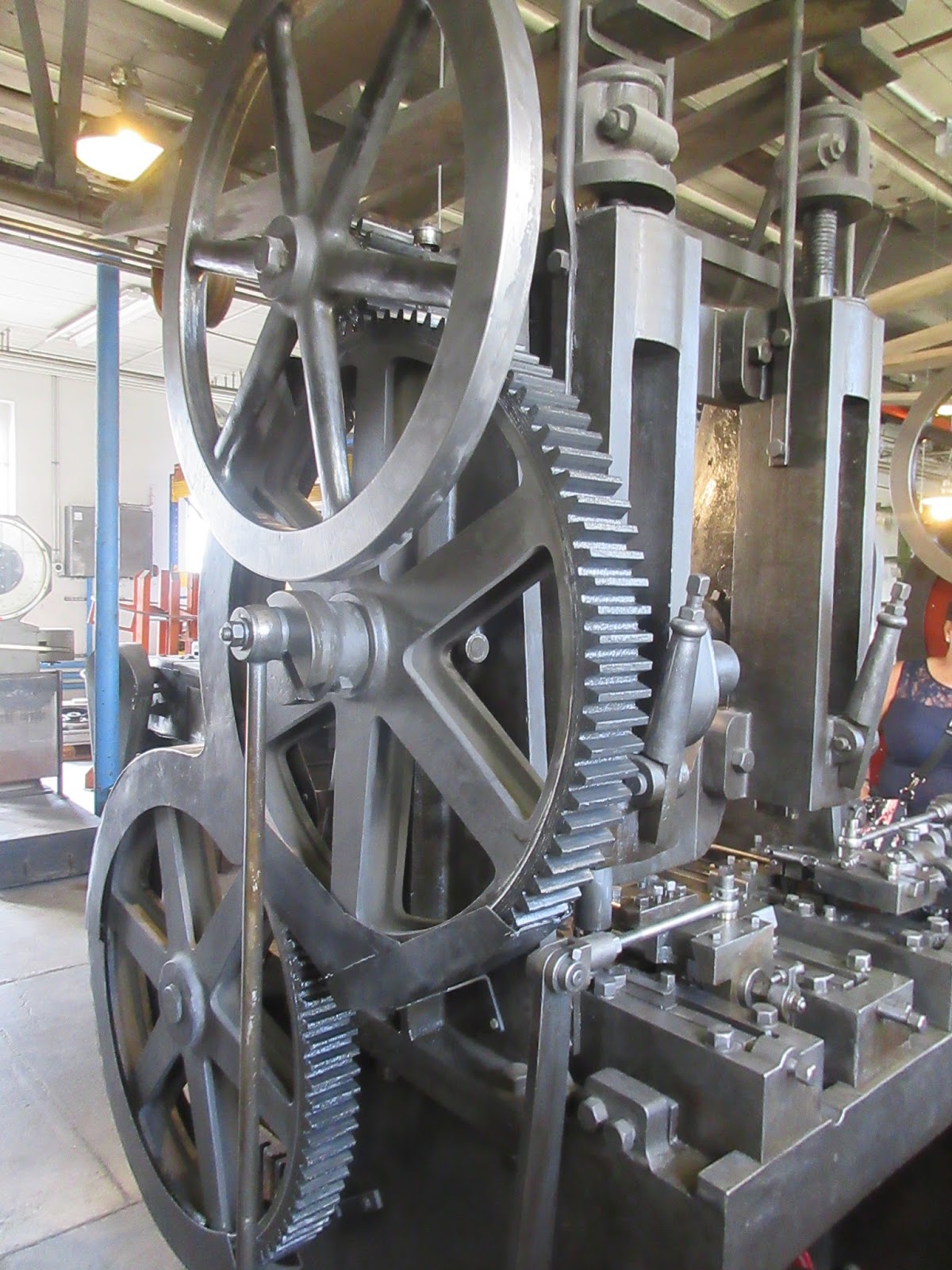
Friday 29 July 2016 was the date set aside for a summer event by ZIWA's Discovering Zurich and Switzerland group. Winterthur is well known for its industrial heritage, as ZIWA members know well from previous visits to the town, but today's trip was slightly more quirky than before. Twelve ladies took the train one step beyond to Winterthur Grueze where we were met by our guide for the morning, industrial archaeologist Dr. Hans-Peter Baertschi, who led us back in time to 1895. Behind the factory door, we were surprised to uncover an active workshop with the original machinery for making nails still in working order.


The northern town's industry dates back to the 19th century and before, when grain, rope, nails and textiles were processed or manufactured. Out of these raw materials, the production of clothing and the machinery to run the mills also evolved. It turned out the manufacture of machinery was more profitable, and hence Switzerland's first machine factory producing steam and diesel engines was located here. In the first half of the 19th century, there were seven railway lines providing transport in the north of the country from Lac Leman to the Bodensee. However, the railway company went bankrupt in 1877, and the town switched over to producing consumer goods and farm produce. The late 20th century saw the decline of the last major Swiss brewery, Haldengut, which was taken over by Heineken ten years ago. So Winterthur's industrial heritage has now all but vanished.


However, at the show workshop in Grueze, thanks to Dr Baertschi, a working nail factory has been lovingly maintained and is run as a family business which employs ten people, two of them women. At the old plant using the original machinery, we saw nails, screws and staples being made. These high quality products are sold to a specialist market and are also used in the production of window fasteners and in railway sleepers and telegraph poles. The raw material comes from the Saar region of Germany, but the end product is sold to the hobby market, using its own on-site packaging materials. On our tour, we saw a machine stamping out the nail heads, wire being transformed into small nails, and other old machinery including  an anvil and smithy. At the factory museum, there was a display of Winterthur's historic products as well as books and postcards on display.


After this step back in time, the group returned to the modern town centre for lunch before the return journey. Thanks to Rowena Woollard for finding this hidden gem.

Julia Newton, 31 July 2016.


Wednesday, 23 March 2016

Visit to the United Nations in Geneva

See also this link: http://www.unog.ch/

Waiting to start our UN tour
Yesterday, Tuesday 22 March, was World Water day, and also the day that the ZIWA Swinging Sixties group visited the UN offices in Geneva. We numbered over 40 ladies in our reserved seats on the 8.03 train from Zurich, and several others joined us at our destination. Experienced chairlady Vreni Riedler once again managed this feat of organisation. The ladies enjoyed the chance to catch up with friends old and new on the train journey.

The flags of the member nations

In Geneva we took a bus to Appia and walked along from there to the UN HQ buildings. Security was in operation and we went through airport-style X-ray checks for ourselves and our bags. At the same time, we were getting word of the terrible terrorist attacks in Brussels, which was very sad. However, once inside the UN building, we were greeted by three guides, and Vreni took charge over the division into two English-speaking and one German-speaking groups. The three groups took slightly different routes through the Palais des Nations and heard different comments.


The UN Organisation
Our ZIWA ladies of several nations

Our guide, Ji, took us upstairs to inspect the board listing all the organisational components of the UN.  We learnt that the General Assembly meets on the second Tuesday in September when each member is allowed to speak for 15 minutes. The UN currently comprises 193 full voting members of the General Assembly and two observers: the state of Palestine is hoping to join, and the Vatican City wishes merely to watch. We saw an image of the 195 flags. The GA votes on topics such as security and the budget, and a two thirds majority is required. The Security Council has five permanent and ten elected members for each two-year term.  They are responsible for peace-keeping missions in the event of conflict - surely an ongoing requirement. Currently the Secretary General is Ban Ki-moon, who is due to step down shortly, and he was preceded by Kofi Annan, who also stood for a nine year term.

Room XX, the Hall of Human Rights
Other branches of the UN organisation include the Secretariat, the Trusteeship Council and the Economic and Social Council. The International Court of Justice is located in the Hague. The UN functions in six languages - English, Chinese, Spanish, Russian, French and Arabic, but the day-to-day working languages in Geneva are English and French.

See more about the organisation structure at this link: http://www.un.org/en/about-un/index.html.

The UN family also includes special agencies such as the International Labor Organisation, the Food and Agriculture Organisation, UNESCO, Unicef, the World Health Organisation, the World Bank and several others who all have their own budget. UN offices are located in New York, Geneva, Nairobi and Vienna.

The Hall of Human Rights and the exhibition hall
Our Chinese guide Ji led us over the bridge from new to old

After the introduction to the UN organisation, we looked into the Hall of Human Rights and Alliance of Civilizations Room where informal conversations were taking place. All formal meetings here are filmed live. It is possible to take a seat in a meeting by reserving in advance.

The art exhibition was impressive
Then we crossed from the new building, over a bridge with views of the grounds, to a large marbled hall known as The Hall of Lost Footsteps. This imposing room featured an exhibition of art works submitted by the member nations. On World Water Day we saw huge paintings, quilts and collages relating to water and other subjects. The old part of the building was founded in 1946 when there were 51 member states. There is a ceiling sculpture by the Spanish artists Miquel Barcelo and was a gift from the Spanish nation.


Room 18 Conference Room

Our third stop was to view a conference centre from the balcony behind a glass screen. We heard something about the organisation of meetings held in Geneva in several small conference rooms with a similar layout. When conferences between warring nations take place, it can be difficult to arrange the seating. In the past, Geneva has hosted meetings of the Afghanistan peace talks, El Salvador, Egypt and former Yugoslavia, as well as meetings involving Iran and Iraq, India and Pakistan and North and South Korea, for example. The member states sit in the front rows and behind them may sit their guests. Geneva employs many translators, some of whom work for the member states and some for the UN itself.

A view into the conference room
The UN budget is based on Gross National Product of its members. The US is the largest with 22 percent of the contribution, while the smallest member pays 0.004 percent. Special projects also have an ad hoc budget allocation. We noticed that the UN building is still relatively low-tech compared to modern high-tech companies.

Cafe de Paris Chez Boubiez
See this link: Chez Boubier

After the three stops on our tour, we met the other groups in the foyer, and after a brief visit to the gift shop, we took the bus 8 back to Cornavin station. From there it was a few steps to the well-known and traditional Cafe de Paris Chez Boubier. We managed to squeeze in all 48 ZIWA ladies for a lunch of the signature, and only, dish of entrecôte of beef accompanied by a sizzling butter sauce, along with French fries and a green salad. By now we were all very thirsty and starving after our busy morning. Thanks again to Vreni for putting it all together.

Julia Newton, 23 March 2016


Friday, 18 March 2016

Wine discovery - Spanish wines

Vinothek Ugarte http://www.vinothek-ugarte.ch/

Another pleasant afternoon with the ZIWA Wine Discovery group and this time a first for many to learn about Spanish wines. Vinothek Ugarte is an old friend of ZIWA's and today they hosted a group of 11 wine lovers in their newly renovated wine shop in Zurich Wollishofen, just a short walk away from the station. Usam Ugarte and Belen Largo, the co-managers, made us feel very welcome. We sat at a table prepared for tasting six Spanish wines - one cava, one white and four red wines - and got ready to make notes. Usam poured out generous tasting samples and Belen explained their origins and methods of production in some detail. We were also tempted by tapas selections.

Wine number 1: Extremarium Brut Reserva, DO Cava, Penedes. Belen explained that Cava (Spanish for cave) is made in the traditional champagne method with a second fermentation. The four grape types used were Xarello, Parallada, Macabeo and Chardonnay. First the wine is fermented in a cave, and then bottled. The bottles are stored vertically on the stopper and turned, allowing the sediment to drop to the bottom. Then it is frozen allowing the stopper and sediment to be removed, before adding the final cork. It is left two years to mature. In a genuine Cava, the bubbles rise from the bottom of the glass. This cava tasted of its mineral origins in a wine area in the north-east of Spain and everyone thought it was delicious.

Wine number 2: Terra Prima White 2014, DO Penedes. This wine comes from a small winery near the sea and the vines are grown on old mining soil. It contains grape types Xarello and Riesling. It is a young wine from a dry, mineral area of northern Spain  and tasted well rounded.

Wine number 3: Piedra Lagar 2013, DO Ribera del Duero. This wine is made from the tempranillo grape. We learnt how to aerate it in the glass by swirling the wine around and waiting a while. The climate in 2013 was unusually irregular which affected the grape production. We heard that there was quantity rather than quality in the grapes that year; this is a young wine for everyday drinking. It was light and pleasant with little tannin.

Wine number 4: Pasas November harvest 2013. DO Jumilla. Our second red was manufactured from the Monastrell grape, also known as Mourvedre, from a late harvest which gave it a certain sweetness. A good market has been developed in the Jumilla region, using 30 year old vines. This wine had six months in oak barrels, and has a 14 percent alcohol content. It should be drunk soon. It was my personal favourite and we ordered a case!

Wine number 5: Syrah Val d'Alferche 2012, DO Somontano. This wine was based on 100 percent Syrah grapes and had its distinctive flavour - full, heavy, dark with a taste of licorice. It was aged in oak in an area of Spain just under the Pyrenees. This wine will keep well up to five years.

Wine number 6: Caliza Marques de Grinon 2010, DO Dominio de Valdepusa. This heavy dark wine  was made in a small region in Toledo, central Spain. It contains grape types Shiraz and Petit Verdot. It tasted strong and dry and would be good with food. The wine could be kept until 2020 and will age well.

After this fascinating lesson in wine production and Spanish wine styles, we learnt the very reasonable prices of each one. Ugarte also stocks other wines from Germany, Austria and Portugal for example as well as spirits and liqueurs such as Pisco, and sherry. It is well worth calling in to see their range of products, and the wines will be delivered promptly. So don't wait! Visit their shop or website now. See link above.

 Julia Newton, 18 March 2016.

Thursday, 15 October 2015

Wine discovery - Asian Food and Suggested Wines

http://www.janefinefood.com/en/

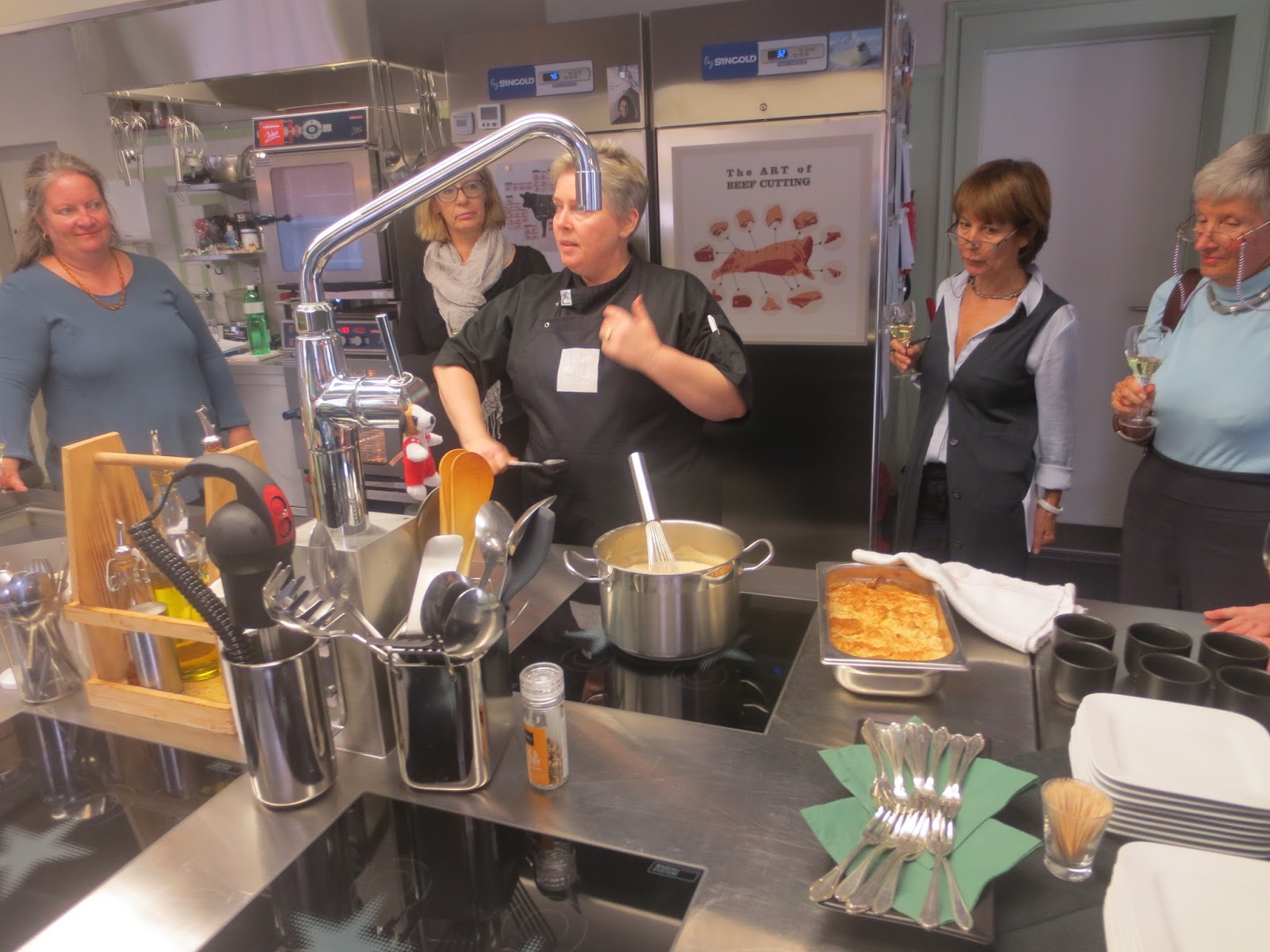
ZIWA's Wine Discovery group always offers pleasurable experiences. And yesterday's visit to old friend Jane's Fine Foods was very popular. Fourteen group members, including one husband, had the chance to sample six freshly-cooked fusion dishes and try a wine suggestion to complement the spicy food. Many people pair spicy food with beer, but a carefully chosen wine could bring out the flavour of both food and wine.

Coconut milk potato gratin and Riesling

The white wine was a sharp, citrussy dry Riesling from Langenlonsheim in the Nahe/Rhine Valley area of Germany. The Tesch 2013 wine would be  suitable as an apero wine on its own, but the spicy potato gratin dish with green curry paste enhanced it even more. Jane mentioned that the potato dish was one of her favourites and could also accompany meat or seafood dishes.

Here's the link to the Tesch website: http://www.weingut-tesch.de/

Peanut satay sauce with Pine Ridge Viognier/Chenin Blanc

The satay sauce was made by heating peanut butter and coconut milk, diluted with water if necessary, with red curry paste flavoured with garlic, chilli and ginger. It was served with vegetable crudites. The Californian white wine was a 2013 blend of Viognier and Chenin Blanc grape types from Pine Ridge vineyards and would be just as good drunk on its own. It had complex notes reflecting the grape types and the mineral soil of the terroir.

Here's the link to the Pine Ridge website: http://www.pineridgevineyards.com/

Grilled prawns with Zweifel Spätlese 

The frozen prawns had been defrosted and marinaded for half an hour in a chilli and garlic marinade with cumin. Jane grilled the prawns in a herby rapeseed oil and then served immediately. Complementing the seafood was a Zurichsee Spätlese 2013 white wine, Vidal Blanc. It had a rather sweet taste.

Here's the Zweifel Hürlimann wine shop link: http://www.zweifelweine.ch/thewineshop_aktuell.cfm
Zweifel is a great source of many wines.

Crab salad with Fusion Gewürztraminer

The crab was obtained frozen, and was served in small portions on a green salad, and tasted spicy and slightly salty. It could also be served with sushi ginger. The dressing was made from rice vinegar, soy sauce, lime and lemon juice and palm sugar. The accompanying wine this time was a Viognier/ Gewürztraminer blend from Fusion wines in California.

You can see the wine at this link: https://www.vivino.com/wineries/us-fusion/wines/viognier-gewrztraminer-9999

Coconut milk soup with Sebastiani Rose

Jane uses this soup mix as the basis for many dishes. It was flavoured with lemongrass, shallot, red curry paste and based on coconut milk from a tetrapack. A rose wine from Sebastiani in California this time went well and gave a kick.

See more about the wine here: http://www.sebastiani.com/

Beef teriyaki and Conundrum red wine

Jane buys her beef fillet from a butcher who supplies quality Australian meat. It was chopped into thin slices and marinaded in Thai sweet chilli sauce with soy and ginger, before frying. Salt should only be added at the last minute. The beef demanded a red wine, another Californian blend, the Conundrum 2012, which was served cool.

Here's the Conundrum website: http://www.conundrumwines.com/

Thanks to Jane for sharing her kitchen, her food and her expertise. A great sharing experience. Cheers!

Julia Newton, 15 October 2015.


Saturday, 12 September 2015

Discovering the underground world of Sasso San Gottardo


Last Tuesday, 8 September a group of 14 ZIWA Discoverers set off on one of the most unexpected discoveries yet: a journey inside the Alps into a secret underground world which until recently was unavailable to members of the public. We visited the fortress of Sasso San Gottardo, a warren of tunnels and rooms built to provide wartime security in case of attack. Rowena Woollard was the instigator of this fascinating journey.

The day trip started in Zurich with the train to Arth Goldau via Zug, where some on the group members joined the tour. On the connecting train from Arth-Goldau to Airolo via the Gotthard rail tunnel, we had to fight for our seats with three other groups in our reserved carriage. But all was well and we arrived in time to catch the post bus to the Gottard- Passhöhe, at an altitude of 2091 metres. Overnight the temperature had caused the museum toilets to freeze, so we were relieved to find a cosy cafeteria inside the bleak mountains. Our guide Marina was happy to serve us coffee and gipfeli while we waited to use the single convenience!

A mountain retreat

Then we were kitted out and ready to take the 500 metre walk through a damp, cold tunnel into the heart of the fortress, known as the Swiss Redoubt. Snug fleeces were the order of the day. At the end of this tunnel we climbed aboard a tiny train to lift us up to the accommodation level where 480 soldiers could be housed. But why bring anyone into this dark, secret world? General Guisan, Switzerland’s wartime army commander, wanted to build not one but 67 such fortresses to provide a safe retreat from the Italian and German forces surrounding the country. The topography of this particular location was suitable strategically and was well protected. But workers were hard to find and keep, and the project took from 1941 to 1945 to complete, by which time the war was over.

Inside the fortress

We saw the Firing Control Centre where calculations were made to determine the angle and range of the projected cannon fire. Four artillery guns were directed through the rock at two angles towards Italy. The soldiers would be shooting blind from within so the calculations had to be accurate. Observers on the outside were in contact by telephone.

We saw a movie, ‘Sasso da Pigna’, about the construction of this twilight world. When Germany invaded Belgium and Holland in 1940, and then France capitulated, Switzerland felt extremely vulnerable. The Alpine passes had to be maintained to allow transport of needed coal and arms. In July 1940, Guisan decided on the redoubt plan which was announced at Rütli in August 1940. He started to build three fortresses inside the Gotthard. The one we visited was facing towards the San Giacomo Pass on the Italian side. The work took four years to complete and cost CHF 900 million.

Still a well-kept secret

In 1944, the threat receded, troops were sent to guard the borders and no more building was done after 1946. During the Cold War, the redoubt became out-dated, but the myth persisted. The underground warren containing dormitories, showers and officer quarters, was used by soldiers on training exercises. On a balcony outside, we could see the cannons poking through the blind rock face. We also saw a small museum with artefacts saved from the war years, including unusual mementoes of General Guisan, the Swiss wartime hero. We also saw the secret plans, which a traitor copied and was later shot.

Lunch in another surprising tunnel!

After viewing more of the warren of tunnels in the fortress, we saw an exhibition of huge, clear crystals brought up from the mining. Then we emerged into daylight briefly to descend to an adjacent tunnel into our lunch venue at La Claustra, a unique hotel complex underground.

Fourteen lucky ZIWA ladies enjoyed an apero and four-course lunch in Ristorante Tremola, delivered to us by our genial host, Rainer Geissmann. Afterwards he very kindly deliver us one by one to the bus stop in his sports car; just in time for the descent via Andermatt to Göschenen and hence Zurich. Unfortunately the SBB service that afternoon was compromised by a broken down train outside Bellizona so the return journey took rather longer than anticipated. However it didn't detract in any way from the fabulous experience.

You can discover more about La Claustra, which is also a hotel, on Facebook.

Julia Newton. 12 September 2015


Wednesday, 22 July 2015

ZIWA Kunsthaus event - July 2015

Europe – The Future of History is the title of a new exhibition at Zurich’s Kunsthaus. Curator Catherine Hug asks, ‘What image represents Europe today?’ She has drawn together an eclectic collection of visual and digital images from the 20th and 21st centuries. On Wednesday, 8 July 2015, ZIWA members had the privilege of a guided tour of some of the 100 art works in the main first floor exhibition gallery. Catherine and her colleague Anna Bähler took us round the show in two groups of 20. It certainly helped our understanding to discover how this collection was selected and what it signified.

The exhibits ranged from Valloton’s The Rape of Europa (1908), a mythological painting in oil on canvas, to an installation of pallets which turned out to be made from polyurethane and not wood. We could enjoy viewing a collection by Dani Gal of record sleeves of famous speeches on vinyl and a series of portrait photos of famous people who have visited Café Odeon in Zurich’s Limmatquai.  A living artist from Geneva had painted a Histoire de Bretagne on the gallery wall while a collection of Breton faience signified the importance of tradition. The Austrian artist Herbert Brandl had created a montage of web images as the basis of his artwork showing the protection of the landscape, while Italian artist Boetti had created a world map in embroidery from a Euro-centric viewpoint.

The reunification of Germany and the destruction of the Berlin Wall were poignant images evoked by a German artist, and another series of painting depicted intimate views of different living spaces. Max Ernst, the German Surrealist, had fashioned another view entitled Europe after the Rain (1933), while another satirical German, Otto Dix, depicted a view of Switzerland from the German side of the Bodensee. There was even a chance to discover the different versions of blue fabric which are used to create the flag of the European Union.


After the one-hour tour which posed many questions about what Europe signifies to us, the ZIWA group convened on the restaurant terrace for an apero arranged by new Events Director Sarah da Ponte. The two guides joined us to answer more of our questions. This exhibition would repay a second visit in order to experience the full selection of art works while perhaps allowing one to speculate on what we would have chosen.


You can read more about this special exhibition at this link: http://www.kunsthaus.ch/en/exhibitions/

ZIWA is an international group comprising many European and international members with diverse mother tongues and home countries. What would your enduring image of modern Europe be?


Julia Newton, 22 July 2015.