Showing posts with label Zurich. Show all posts

Monday, 21 November 2016

Beyer Clock Museum - and Diamonds

See also:
http://www.beyer-ch.com/en/museum/portrait-museum.html


On Wednesday 16 November, another large group of ZIWA's Swinging Sixties met at Paradeplatz in Zurich to go on a tour of discovery of the nearby Beyer Clock Museum. There are signs to the museum all down the famous Bahnhofstrasse, but how many people had been inside the store made prominent by the enormous pocket watch outside? Once again, chairlady Vreni had laid on a fascinating morning for us.

Inside the small premises, we were divided into two groups and welcomed by our guides, Monika Winkler and Beatriz Bretschergartner. One group went downstairs to see the collection of antique timepieces while the others headed upstairs to see some of the gorgeous jewellery that we might aspire to own. In 1971, Theodor Beyer founded the family business and opened his collection to the public. We learnt that the history of timepieces dates back to 1400 BC, with the invention of dials, water and fire clocks. An early timepiece was the sundial which utilises a shadow stick to display light and dark. And the Sumerians were even able to measure time in steps as early as 2000 BC. The first sundials were known to exist in 200 BC; but the earliest clock in the Beyer collection was a copy of a water clock dating back to 1140 BC, which had 12 time gaps marked.


The Greeks refined the timepiece which was important at court; and we still say that 'time has run out' thanks to a sand timer. Wax candles were used in the ninth century but were expensive to make, and hourglasses were popular in the 13th century. The museum also features an early European mechanical clock dating from 1532. Monasteries and ships all needed to have reliable timepieces, and the sun and sand have both been popular for measuring the passage of time.


In the 17th century, clocks for the home became popular status symbols, with the mechanics utilising a folio and balance wheel or a pendulum. Then portable clocks became the rage, with clocks for the table and watches to attach to one's clothing as a fashion accessory. The museum has many splendid examples of clocks and watches from Theodor Beyer's private collection. Switzerland became famous as a maker of beautiful and reliable timepieces. However, when Japan developed the quartz watch, they could now beat the Swiss on price, but the Swatch remains ever-popular.


After this fascinating glimpse into the history of clocks and watches, we went upstairs to see and handle the other side of the Beyer business, its precious stones and diamond rings. There is a workshop on the premises, where diamonds, sapphires and emeralds from Africa or South America are fashioned into very expensive jewellery. Under the eyes of a security guard, we were able to try on a Madagascan sapphire ring and to hear how diamonds are given a unique number by laser. Rings of emerald, garnet, citrine and beryl are fashioned and sold here, and everyone had the chance for a few minutes to choose their dream item.

Afterwards we walked the short distance to the newly opened Moevenpick 20/20 restaurant for a very pleasant lunch. Thanks once again to Vreni for arranging this fascinating morning.

See also this link: https://www.moevenpick-wein.com/de/weinkeller/20-20-by-moevenpick-wein-restaurant.html

Julia Newton, 21 November 2016.


Monday, 24 October 2016

What's your wine type? Tasting six European wines with Wine Discovery

Wine Discovering chairlady Evi Hock has many contacts in the wine business and on 5 October 2016, she introduced us to wine expert Barbara Hulsbergen at a very special wine tasting event. Barbara is a member of the executive board of Nüesch Weine and founder and chairlady of Die Weinausbildung. Evi told the group of 17 wine enthusiasts who gathered at her home, that she got to know Barbara at a professional wine tasting event many years ago and was very impressed with her extensive wine knowledge. Evi commented that what Barbara doesn't know about wine really isn't worth knowing!  

Barbara introduced six different styles of wine. Throughout the tasting, she helped us work out which is our favourite style and also gave us some handy tips on food pairing. It was a fun and informative afternoon.

Barbara mentioned her dual role as member of the family wine distributing business and a wine educator. She felt that wine appreciation was very much down to personal taste, and as we worked our way through three whites and three red wines, all from Europe, the wine lovers of our ZIWA group compared comments on their experiences and impressions, before seeing the labels.


1. Spanish Dry White. It had a fruity smell and a citrus taste, with balanced acidity. Barbara mentioned that the EU has rules regarding the amount of sugar content, and that the grapes must be of good, healthy quality. This wine was a Rueda from Northern Spain, a Valdelapinta 2015. The grape type was Verdejo. This wine would be good paired with seafood or cheese.


2. Italian White. A fresh taste which was quickly identified as Pinot Grigio, like the Pinot Gris but from a different terroir. It was fresh and fruity in the mouth, with a delicate aroma. It would be good served with pasta or risotto. La Tunella came from the Friuli region and has been kept for one to two months in the cellar.


3.  Grüner Veltliner comes almost exclusively from Austria, which has overcome its one-time bad reputation as a wine producer. This one was a Weinrieder 2014 and was dry, with a straw colour which had full flavour and a very pleasant taste.


4. Merlot. The first of our reds came from the Swiss Ticino, and impressed with its aroma. While still young, the 2014 Baicco had a full, dry taste, would be good with meat and would benefit from keeping. You could also serve it with polenta, risotto or a rabbit dish. It could also accompany cheese and dried meats.


5. Bordeaux Lamothe 2009 ‘Cru Bourgeois’, a French red from the Haut Medoc with a blend of Cabernet Sauvignon, Merlot and Cabernet Franc grapes. The Bordeaux appellation is a very special designation. This wine had good aroma and colour with a taste of tannin and a hint of vanilla.


6. Santi Nobile Terre Siciliane. Our final wine came from Sicily and comprised Nero d’Avola and Cabernet Sauvignon grapes. It had a dark red, almost purple colour and a spicy, chocolatey taste. This 96 Luca Maroni was Barbara’s choice of the afternoon.


You can learn more about Barbara’s credentials at the links below:


Once again, ZIWA Wine Discovery charladies Evi and Marianne hosted a great afternoon of wine tasting, with long-standing and newer group members present. The group's next two dates are Tuesday 8 November to taste port on the Expovina wine ships and Monday 5 December 2016 for an apero and final event for our hostesses. Thank you for many years of wine-tasting pleasure.

Julia Newton, Tuesday 11 October 2016.


Friday, 18 March 2016

Wine discovery - Spanish wines

Vinothek Ugarte http://www.vinothek-ugarte.ch/

Another pleasant afternoon with the ZIWA Wine Discovery group and this time a first for many to learn about Spanish wines. Vinothek Ugarte is an old friend of ZIWA's and today they hosted a group of 11 wine lovers in their newly renovated wine shop in Zurich Wollishofen, just a short walk away from the station. Usam Ugarte and Belen Largo, the co-managers, made us feel very welcome. We sat at a table prepared for tasting six Spanish wines - one cava, one white and four red wines - and got ready to make notes. Usam poured out generous tasting samples and Belen explained their origins and methods of production in some detail. We were also tempted by tapas selections.

Wine number 1: Extremarium Brut Reserva, DO Cava, Penedes. Belen explained that Cava (Spanish for cave) is made in the traditional champagne method with a second fermentation. The four grape types used were Xarello, Parallada, Macabeo and Chardonnay. First the wine is fermented in a cave, and then bottled. The bottles are stored vertically on the stopper and turned, allowing the sediment to drop to the bottom. Then it is frozen allowing the stopper and sediment to be removed, before adding the final cork. It is left two years to mature. In a genuine Cava, the bubbles rise from the bottom of the glass. This cava tasted of its mineral origins in a wine area in the north-east of Spain and everyone thought it was delicious.

Wine number 2: Terra Prima White 2014, DO Penedes. This wine comes from a small winery near the sea and the vines are grown on old mining soil. It contains grape types Xarello and Riesling. It is a young wine from a dry, mineral area of northern Spain  and tasted well rounded.

Wine number 3: Piedra Lagar 2013, DO Ribera del Duero. This wine is made from the tempranillo grape. We learnt how to aerate it in the glass by swirling the wine around and waiting a while. The climate in 2013 was unusually irregular which affected the grape production. We heard that there was quantity rather than quality in the grapes that year; this is a young wine for everyday drinking. It was light and pleasant with little tannin.

Wine number 4: Pasas November harvest 2013. DO Jumilla. Our second red was manufactured from the Monastrell grape, also known as Mourvedre, from a late harvest which gave it a certain sweetness. A good market has been developed in the Jumilla region, using 30 year old vines. This wine had six months in oak barrels, and has a 14 percent alcohol content. It should be drunk soon. It was my personal favourite and we ordered a case!

Wine number 5: Syrah Val d'Alferche 2012, DO Somontano. This wine was based on 100 percent Syrah grapes and had its distinctive flavour - full, heavy, dark with a taste of licorice. It was aged in oak in an area of Spain just under the Pyrenees. This wine will keep well up to five years.

Wine number 6: Caliza Marques de Grinon 2010, DO Dominio de Valdepusa. This heavy dark wine  was made in a small region in Toledo, central Spain. It contains grape types Shiraz and Petit Verdot. It tasted strong and dry and would be good with food. The wine could be kept until 2020 and will age well.

After this fascinating lesson in wine production and Spanish wine styles, we learnt the very reasonable prices of each one. Ugarte also stocks other wines from Germany, Austria and Portugal for example as well as spirits and liqueurs such as Pisco, and sherry. It is well worth calling in to see their range of products, and the wines will be delivered promptly. So don't wait! Visit their shop or website now. See link above.

 Julia Newton, 18 March 2016.

Thursday, 15 October 2015

Wine discovery - Asian Food and Suggested Wines

http://www.janefinefood.com/en/

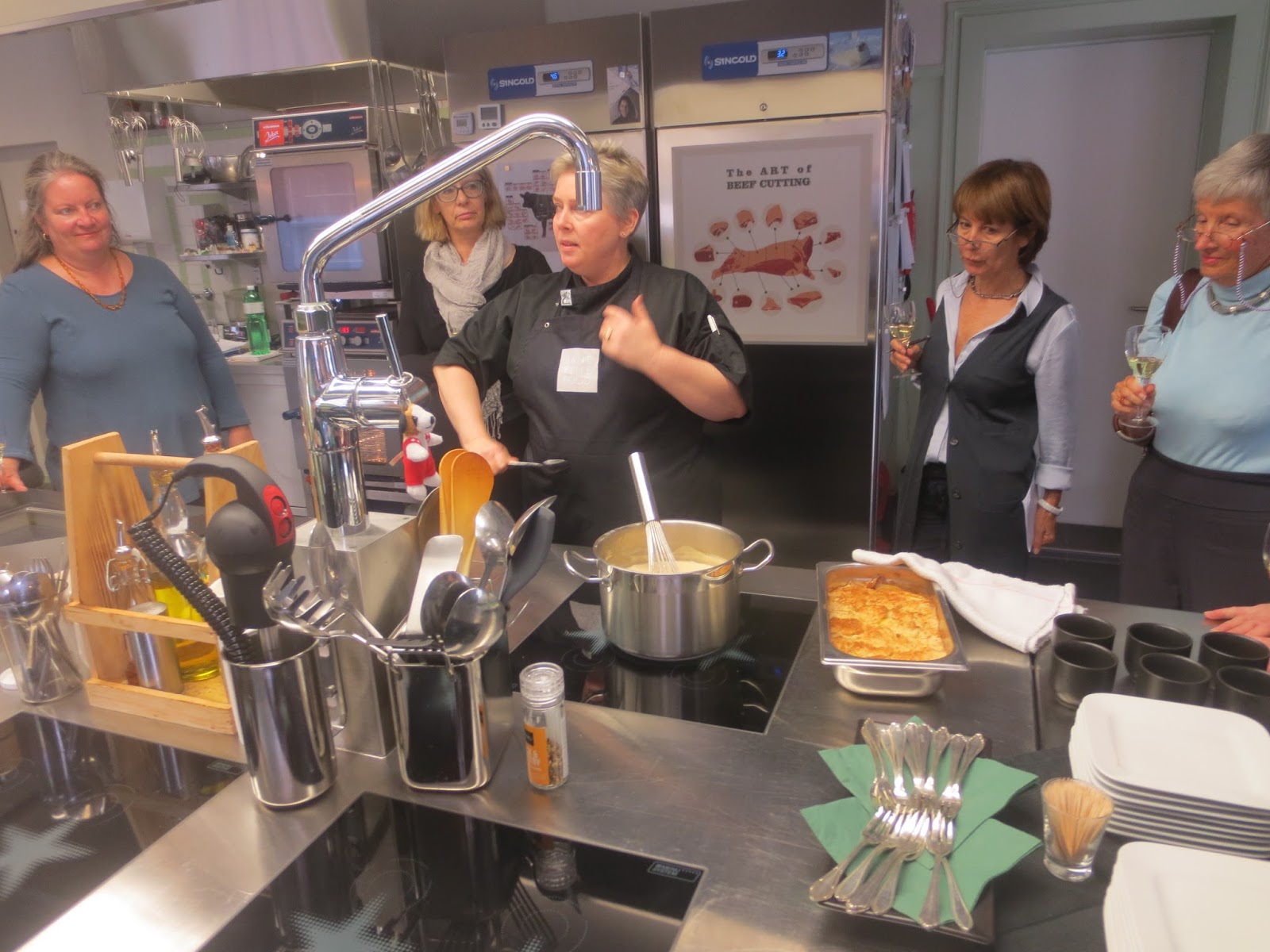
ZIWA's Wine Discovery group always offers pleasurable experiences. And yesterday's visit to old friend Jane's Fine Foods was very popular. Fourteen group members, including one husband, had the chance to sample six freshly-cooked fusion dishes and try a wine suggestion to complement the spicy food. Many people pair spicy food with beer, but a carefully chosen wine could bring out the flavour of both food and wine.

Coconut milk potato gratin and Riesling

The white wine was a sharp, citrussy dry Riesling from Langenlonsheim in the Nahe/Rhine Valley area of Germany. The Tesch 2013 wine would be  suitable as an apero wine on its own, but the spicy potato gratin dish with green curry paste enhanced it even more. Jane mentioned that the potato dish was one of her favourites and could also accompany meat or seafood dishes.

Here's the link to the Tesch website: http://www.weingut-tesch.de/

Peanut satay sauce with Pine Ridge Viognier/Chenin Blanc

The satay sauce was made by heating peanut butter and coconut milk, diluted with water if necessary, with red curry paste flavoured with garlic, chilli and ginger. It was served with vegetable crudites. The Californian white wine was a 2013 blend of Viognier and Chenin Blanc grape types from Pine Ridge vineyards and would be just as good drunk on its own. It had complex notes reflecting the grape types and the mineral soil of the terroir.

Here's the link to the Pine Ridge website: http://www.pineridgevineyards.com/

Grilled prawns with Zweifel Spätlese 

The frozen prawns had been defrosted and marinaded for half an hour in a chilli and garlic marinade with cumin. Jane grilled the prawns in a herby rapeseed oil and then served immediately. Complementing the seafood was a Zurichsee Spätlese 2013 white wine, Vidal Blanc. It had a rather sweet taste.

Here's the Zweifel Hürlimann wine shop link: http://www.zweifelweine.ch/thewineshop_aktuell.cfm
Zweifel is a great source of many wines.

Crab salad with Fusion Gewürztraminer

The crab was obtained frozen, and was served in small portions on a green salad, and tasted spicy and slightly salty. It could also be served with sushi ginger. The dressing was made from rice vinegar, soy sauce, lime and lemon juice and palm sugar. The accompanying wine this time was a Viognier/ Gewürztraminer blend from Fusion wines in California.

You can see the wine at this link: https://www.vivino.com/wineries/us-fusion/wines/viognier-gewrztraminer-9999

Coconut milk soup with Sebastiani Rose

Jane uses this soup mix as the basis for many dishes. It was flavoured with lemongrass, shallot, red curry paste and based on coconut milk from a tetrapack. A rose wine from Sebastiani in California this time went well and gave a kick.

See more about the wine here: http://www.sebastiani.com/

Beef teriyaki and Conundrum red wine

Jane buys her beef fillet from a butcher who supplies quality Australian meat. It was chopped into thin slices and marinaded in Thai sweet chilli sauce with soy and ginger, before frying. Salt should only be added at the last minute. The beef demanded a red wine, another Californian blend, the Conundrum 2012, which was served cool.

Here's the Conundrum website: http://www.conundrumwines.com/

Thanks to Jane for sharing her kitchen, her food and her expertise. A great sharing experience. Cheers!

Julia Newton, 15 October 2015.


Wednesday, 29 April 2015

Restaurant of the Month - April 2015

Restaurant Blaue Ente, Muehle Tiefenbrunnen, Seefeldstrasse 223, 8008 Zurich.

http://blaue-ente.muehle-tiefenbrunnen.ch/

For our last outing with the ZIWA Dining Around the World group, we met for lunch at the Restaurant Blaue Ente at Zurich Tiefenbrunnen. The journey there from the main station takes 15 minutes by tram and it is located in the courtyard of the Muehle, next to Miller's Studio and the Muehlerama Museum. Sadly it was too wet yesterday to sit outside on the attractive terrace, but inside the restaurant is spacious and features an old mill wheel. Our group of ten ladies received excellent service and we all opted for one of the daily menu choices.


Today's selection featured either a mixed salad or carrot and ginger soup, which was delicious, followed by crispy cod with chervil on a bed of seasonal asparagus and a carrot couli, which most people opted for. We could also choose beef stroganoff with spaetzli or taglierini pasta with chilli. It was all freshly cooked, served hot and tasted delicious. Some of us opted to share a bottle of Austrian Weissburgunder wine, and even splashed out on a second bottle. Drinks and coffee were extra, and bread and a choice of waters were already on the table. The menu cost between CHF 23 for the pasta option to CHF32 for the beef; the fish menu cost CHF27.

Service was very attentive and the restaurant was pleasantly full but spacious. On a fine day it is very pleasant to linger on the terrace, There is also a bistro serving coffee and baked goods, taking advantage of the neighbouring mill museum which produces and sells bread, muesli and other bakery products. The pasta served in the Blaue Ente is the hand made Costa D'Oro brand made locally. And on Friday evenings there is live music in the piano bar.

Have a look at the website link above for all the options and to reserve. It's worth taking the time to find the Blaue Ente for its character, service and delicious food and wine.

Viel vergnuegen! 

Tuesday, 3 March 2015

Discovering Zurich’s Ambassador Hotel and the nearby Opera House


A special treat for members of ZIWA’s energetic Swinging Sixties group was in store on Tuesday 24 February, thanks to the organising skills of its chairlady Vreni Riedler. Over 30 ladies gathered in the foyer of the small but very welcoming Ambassador à l’Opera Hotel just behind the imposing Opera House building in Zurich Bellevue. Three guides from the hotel staff were on hand to take us on a tour from cellar to roof of this small gem of a hotel.


We discovered that the hotel is a family-run concern and has been recently renovated. Each floor is dedicated to a particular operatic composer such as Verdi or Wagner, and we were invited inside some of the bedrooms to see the special touches provided to make guests feel welcome. We emerged onto the roof terrace with its splendid view over the city, and saw where on a warmer day one might enjoy a picnic or a sun lounger.

Then we descended into the warren of rooms comprising the kitchen, storage rooms and cellars. Here the planners had been very creative in making use of every corner of space. We met the ten-strong team of chefs and kitchen assistants in the small domain comprising the food washing station, the meat and fish cooking area and the vegetable preparation area. The Ambassador prides itself on its fish specialities in its restaurant with sixty covers. The building dates back to 1898 and has been substantially renovated. In total 16.8 million Swiss francs have been spent on the renovations over the past 10-15 years.

We also discovered that while the hotel has space for its weekly wine and beer requirements in a temperature-controlled environment, there is also an offsite wine cellar with even more capacity.  Some laundry is done on site and the rest is sent out; the hotel staff all have a uniform. We explored the air filter system, the silver cleaning room, the water softener and the gas tumbler. The hotel employs 70 staff who can also have their lunch in specially designated spaces. Heat is recycled from the kitchen and supplemented by a gas heater.  One of the limitations on space in the underground areas is because of the high water level due to the adjacent lake of Zurich, and the location of the drainage system under the cellar floor. A close eye is kept on the underground water level which must not rise higher than 4.04 metres above sea level.

After exploring the hotel from top to bottom, the three groups convened in the restaurant for a lunch of soup and fish with optional wine. We admired the ceiling and walls painted by a young Swiss artist, Tatjana Tiziana. We were invited to take part in a quiz to test our knowledge and attention on the earlier tour. See below* for quiz answers and prizewinners.

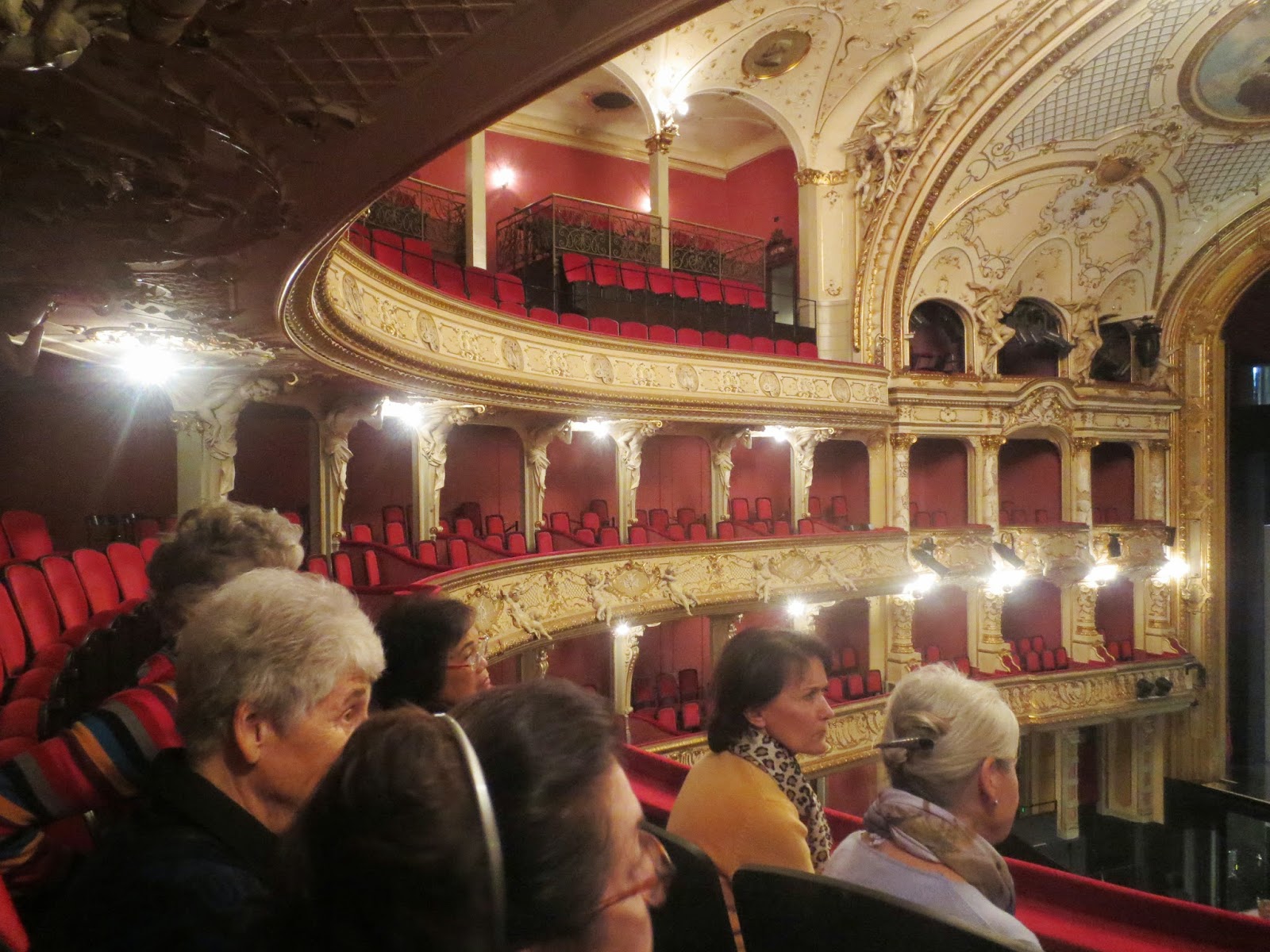
After this amazing experience, the ladies left taking a small gift of chocolates each, and walked across to the Opera House for another set of tours. First we sat in the audience and saw a new stage set being built for one of the premieres, Rote Laterne, which was not to be photographed until after its first show. A second premiere, Juliette, was also in preparation.  Each of the two groups  was able to explore on the stage, and then backstage where we saw the sets being stored, the costumes hanging up ready and props used for the shows. Each matinee and evening show requires the sets to be put up in a short time before the next performance, so the stage crew have to practice setting up each new production. There was a vast array of costumes for every performer and scene, not to mention the racks of shoes and hats. Wigs are made by hand to suit each performer. The ballet productions are even more demanding on shoes. Our guides gave us a vivid picture of life behind the scenes of the opera with its ever-changing repertoire.

Zurich Opera House was built in 1890-91 by two experienced architects, Helmar and Felder from Vienna, and it can accommodate 1100 seats at full capacity. The foyer and stockrooms were added later and the stage has been recently redesigned to allow a complex repertory program of changing productions. The Opera Ball is also held in the house in March. As with the Ambassador Hotel, the Opera House is built on oak stilts because of the underlying water. It’s an amazing feat of construction and host to numerous international stars.

*The quiz questions were a) How many tonnes of washing per year is done at the hotel? 68 Tonnes. b) How much money has been invested in renovation in the past 10 years? CHF 16.8 million. c) On what foundation is the Ambassador Hotel built? On oak piles. Tiebreaker question: How many steps are there from the cellar to the roof terrace? 158.

The winners of the Ambassador Hotel quiz were: first prize Marijke Largiader, second prize Junita Keil. Congratulations to them!


Julia Newton, 3 March 2015.

Friday, 19 December 2014

Restaurant of the Month - December 2014

Restaurant Gruenes Glas, Untere Zaeune 15, 8001 Zurich

http://www.gruenesglas.ch/home

For our final event of 2014, the ZIWA Dining Around the World group chose to celebrate at the Gruenes Glas, a traditional restaurant which has recently been renovated. It was a popular choice for a pre-Christmas lunch, judging by the number of diners. We chose a menu from the Winter Selection and selected our dishes in advance to speed up the meal. The service in any case was very attentive.


Our choices included Nuesslisalat, smoked duck salad or mushroom tortelloni followed by monkfish or boeuf bourguignon with suitable vegetables. Drinks could be chosen by the glass to complement the meal.  As soon as our order was confirmed, the dishes arrived. Everyone was happy with their choice.


The setting in the restaurant was intimate in our own private booth, and the table was nicely decorated for the festive season. A great choice for our last event before Christmas. The Winterkarte contained a large selection of typical Swiss specialities including salads, soups and fish to start, followed by beef tartar, pasta, fish and a creative selection of meat dishes for the main course.


We didn't opt for desserts, but were pleased to receive a tasting portion of pistachio cream to round of the meal before our coffee. The two course meal plus water and coffee cost each of us CHF60, with wine by the glass extra. You can also choose from the menu of the day or the a la carte, and there is an extensive wine list which includes wines by the glass and a big choice of Swiss and European wines.


The Zum gruenen Glas restaurant is part of a Zunfthaus, which also fronts onto Obere Zaeune in Zurich Altstadt. But the restaurant entrance is at the other side in Untere Zaeune 15. It is located behind the Kunsthaus, a few minutes' walk away. For a special meal in a traditional setting, with modern cuisine and excellent service, why not try the Gruenes Glas? You need to reserve in advance though.

Zum wohl mitenand! 

Tuesday, 11 November 2014

Zurich Observatory tour and dinner

On Wednesday 5 November, members of the ZIWA Swinging Sixties group, a large number of ladies, congregated in The Lion bar for a drink prior to a tour of Zurich's Sternwarte or Observatory. You may have often noticed this landmark in Uraniastrasse, and may even have visited the lofty Jules Verne bar, but we discovered a viewing gallery even higher up. Access is possible by lift to the bar and then by a staircase. The 360-degree view on this night was spectacular.

Our guide, Herr Weil, told us about the founding of the observatory in 1907 for the people of the city of Zurich. The 12 tonne steel telescope is housed on a concrete stand which is set into the earth. The telescope rotates to enable a view of the night sky towards the geographic north and Polaris. We were already impressed by the views over the city with its famous churches - the Grossmunster, Fraumunster and St Peter's for example, as well as many other familiar landmarks. In spite of the light pollution, the Zeiss-made telescope lens enables a view of the night sky through two panels which open. The refracting, colour-correcting lens has a magnifying power of 2500 times that of the human eye.

Herr Weil gave us an astronomy lesson about the solar system, the planets and the stars. Closest to earth is our moon, one of over 172 moons in the solar system.  The American Lunar Reconnaissance Orbiter (LRO) which was launched in 2009, is constantly taking photos of the moon and plots its varying distance from the earth during its orbit. Light from the sun takes 8 minutes to reach the earth. We were reminded always to use filters when observing the sun, though. A partial solar eclipse is expected on 22 March 2015.

We also learnt that the eight planets, excluding Pluto, all lie in the same plane, along with the asteroid belt. The sun was formed out of a cloud of hydrogen and dust particles and is 10 million degrees inside. Scientists predict that our sun will die in five billion years' time and become a white dwarf. Comets are formed from ice and snow, and the European (ESA) Rosetta project is planning to land a probe on one on 12 November 2014. The stars are 9.5 billion kilometers away, more than four light years. With our current technology we cannot contact other life forms as the time to reach them, if they existed, would be too great. There are 88 constellations of stars  in our galaxy, many of which we can view with the naked eye. Some of the most familiar are Orion, the Great Bear, Cassiopeia and those named after the signs of the zodiac.

You can visit the Observatory on Thursday, Friday, and Saturday evenings from 20.00 without an appointment. See more at this link: http://www.urania-sternwarte.ch/


After the fascinating tour, group chairlady Vreni Riedler led us over the historic Lindenhof to the traditional Lindenhofkeller for a pre-arranged four course dinner. Our hosts introduced the two selected wines from a French vineyard near Perpignan, before serving us with an amuse-bouche prior to the delicious dinner.


We enjoyed Zander filet in filo pastry with beetroot, apple and horseradish salad, a small pumpkin soup topped with foam, black Angus steak, beautifully served, with roast potatoes and vegetables, and finally a tonka bean panna cotta with mango sorbet and mango and passion fruit compote. It was all beautifully presented and cooked, and the company as usual was also very pleasant.

Read more about the restaurant at this link: http://www.lindenhofkeller.ch/

 En guete!

Monday, 29 September 2014

Swiss cheeses

These cheeses were featured in a tasting at the ZIWA Kick-Off on 23 September 2014


Tilsiter Mild


Tilsiter cheese is a light yellow semi-hard cheese, created in the mid-19th century by Prussian-Swiss settlers, the Westphal family, from the Emmental valley. The same ingredients to make the cheese were not available as in their home country and the cheese became colonized by different moulds, yeasts, and bacteria in the humid climate. The result was a cheese that was more intense and full flavoured. The settlers named the cheese after Tilsit, the Prussian town in which they had settled.

Tilsiter has a medium-firm texture with irregular holes or cracks. Commercially produced Tilsiter is made from pasteurized cow's milk, ranges from 30 to 60 percent milk fat and has a dark yellow rind. After the main part of its production, the cheese needs to rest for an additional 2 months.
Nowadays it’s manufactured in more than one location and the milk comes from north and east Switzerland.

Using the re-imported recipe, Tilsiter has been manufactured in Switzerland since 1893. Swiss Tilsiter is mainly produced in 3 varieties. A mild version (green label) is made from pasteurized milk, a more strongly flavoured one from fresh, unpasteurized milk (red label), and the yellow-labeled "Rahm-Tilsiter" is produced from pasteurized milk with added cream.


Appenzeller Surchoix

Appenzeller cheese is a hard cow's-milk cheese produced in the Appenzell region of northeast Switzerland. A herbal brine, sometimes incorporating wine or cider, is applied to the wheels of cheese while they cure, which flavors and preserves the cheese while promoting the formation of a rind.

Appenzeller has a documented history of at least 700 years. 

Today, about 75 dairies produce it, each with a different recipe for their brine wash. Most of the recipes are trade secrets.
The cheese is straw-colored, with tiny holes and a golden rind. It has a strong smell and a nutty or fruity flavor, which can range from mild to tangy, depending on how long it is aged. Three types are sold:
  • "Classic". Aged three to four months. The wheels are wrapped in a silver label.
  • "Surchoix". Aged four to six months. Gold label.
  • "Extra". Aged six months or longer. Black label.


Gstaader Mutschli

From the Berner Oberland Saanen region of south-east Switzerland. You can visit the cheese factory there: http://www.molkerei-gstaad.ch/

Mutschli is a 'HalbhartKäse' or Half hard (semi hard) cheese produced in the Canton of Bern.

Mutschli is the Bernese version of the common 'Hirtenkäse' or Herdsman's cheese. These cheeses were traditionally made for the direct consumption by the farmers, rather than for sale. As such they are softer so that they do not need to be aged as long, often being eaten after a few weeks of ageing. Historically speaking, these are probably the oldest cheese type, the longer aged alpine cheeses being adapted from them by adjusting the recipe so that they store better, being more suited to transport across long distances.


All cheeses from Switzerland

·                     Sbrinz
·                     Emmentaler
·                     Swiss cheese
·                     Gruyère/Greyerzer
·                     Berner Alpkäse
·                     Schabziger
·                     Appenzeller
·                     Bündner Bergkäse
·                     Mutschli
·                     Raclette
·                     Tête de Moine
·                     Vacherin Fribourgeois
·                     Tilsiter
·                     Vacherin Mont d'Or
·                     Formaggini
·                     Gala
·                     Büsciun da cavra
·                     L'Etivaz
·                     Tomme vaudoise


Visit the Bern Cheese Festival - 25 October 2014: Bern cheese festival


Julia Newton, 23 September 2014


Wednesday, 27 August 2014

Restaurant of the Month - August 2014

Drei Stuben, Beckenhofstrasse 5, 8006 Zurich

http://dreistuben.ch/

On a late summer's day, a garden restaurant is ideal. However, with a summer like this past one, a cosy indoor salon is a better bet. Drei Stuben catered to both alternatives: yesterday the rain won the day. Fourteen discerning ladies from ZIWA's Dining Around the World group gathered for lunch in the traditional wood-panelled interior of this typically Swiss place only two tram stops away from Zurich's main station. There was no shortage of conversation and good food.


We all opted for the set menu choices - salad or potato soup followed by Rotbarsch with potatoes, cucumber salad and a remoulade sauce or rolled veal with jus and pasta. The food is nicely presented and tasty. And the price is very reasonable - under CHF 40 for a two-course meal with water and coffee. On sunnier days, the outdoor experience is to be savoured.


The restaurant offers a selection of classic dishes done with modern flair. They also offer a five-course set menu for a special occasion. And the dessert card is impressive too. Chef Michael Bollinger and his team have refreshed the menu selection with dishes to appeal to all the senses. But the traditional setting remains familiar.

So for a taste of old-fashioned Switzerland  with a modern twist, you might like to try Drei Stuben in the university quarter of Zurich.

Enjoy your lunch!


Tuesday, 4 February 2014

Restaurant of the Month January 2014

Restaurant Metropol, Fraumunsterstrasse 12, 8001 Zurich

http://www.metropol-restaurant.ch/metropol/en/start.html

ZIWA's Dining Around the World group enjoyed their first event of 2014 with a congenial lunch at one of Zurich's chicest restaurants. The Metropol 'combines refined taste and a feeling of style and atmosphere', according to their website, and this was also our experience. The Business Lunch features a daily menu of two starters and a meat, fish and vegetarian option, combined with the choice of a Japanese Bento box consisting of a sushi and sashimi starter with soup and a choice of three main courses. We could also have opted for the Daily Classic or the Seasonal Special. Most of the ladies in our group opted for the Bento box, and the sushi menu is one of the Metropol's best lunch choices.  Expect to pay around CHF 35-40 for a two course lunch, plus drinks.

The service was impeccable, as the maitre d'  took our coats and the waitress brought us water. Orders were swiftly taken and we sat back to enjoy  the conversation with a sociable group of older and newer members from at least six countries.

The Metropol is very conveniently located close to the Bahnhofstrasse and the Lake of Zurich, and in summer also offers an outdoor terrace as well as an indoor bar area with its own bar snacks menu. The lobster soup is always a winner here. And the a la carte menu offers a great selection of international dishes.

For a chic and stylish meeting place for two people or a group, or for a solitary business lunch in one of Zurich's neo-Baroque houses, the Metropol is hard to beat.

Friday, 1 November 2013

Restaurant of the Month October 2013

James Joyce Irish Pub - Pelikanstrasse 8, 8001 Zurich

http://www.jamesjoyce.ch/
An informal lunch in an Irish pub was enjoyed by 12 members of ZIWA's Dining Around the World group on the last Tuesday of October. The bar staff welcomed us warmly and had set aside a whole bay where we could chat and enjoy some typical pub grub. As well as two daily specials and a dessert choice, we could select from some of the classic dishes including Fish and Chips, the James Joyce complete hamburger and the Club Sandwich. All washed down with a glass or two of Irish draught Guinness.

The bar, located just off Zurich's famous Bahnhofstrasse, has a fascinating history. James Joyce, the renowned Dublin writer, spent many years in Zurich and indeed also died and was buried here. As the pub website tells us,


'The interior furnishing originates from the Jury's hotel in Dublin and was run there as the Antique Bar.

'At the beginning of the 1970s,  the hotel had to give way to urban development measures. At an auction a businessman from Zuerich purchased the interior furnishing and sold it to the SBG (now UBS) at that time. They had the far-sightedness and honoured a guest of many years' standing and friend of the Zuerich city (James Joyce) in this special way.

'The 19th century Art Nouveau bar is considered worldwide as one of the most beautiful bars, as it has been protected and preserved entirely.

'An Irish bar situated in Zuerich may therefore very well be called the James Joyce Bar.'  

The bar is a popular lunchtime venue for local bankers and businessmen, and it is usually advisable to book. Unlike most English pubs, at Zurich's James Joyce there is waiter service and an attractive menu which in October contained a nice selection of autumn specials as well as typical British and some Swiss dishes. The beer selection includes the famous black gold, the Guinness being served in small or large glasses. Having tasted the real stuff in Dublin only a week ago, I found the Swiss ale rather weak compared to the Irish brew. But still tasty. There is a wide choice of beers on draught and bottled as well as whiskies, and unlike most Irish bars, an extensive wine list.

The pub also opens in the evenings but food isn't served until 6pm and the atmosphere is a little more subdued then. However whatever the time of day or evening, you can be sure of a warm welcome with an enticing selection of Irish, British and international food and beverages. Cheers!