Showing posts with label Discovering Zurich and Switzerland. Show all posts

Friday, 30 June 2017

Chur rediscovered – Switzerland’s oldest city showing signs of change

Wednesday 14 June 2017

Several people on yesterday’s visit by ZIWA's Discovering Zurich and Switzerland group who had also been there with the group in 2009 noticed that the train station has been modernised since then. Outside the station we met our guide Caroline Lampert, who pointed out a modern artwork based on lotus flowers, which was certainly a surprise. And we were pleased that many of the streets around the old city have been pedestrianised, making our walking tour much easier. However, as we left Zurich in sun and arrived in Chur in rain, several ladies dived into the local shops to buy umbrellas.

Chur is Graubunden’s largest city where three languages are spoken – Rhaeto-Romansch, Italian and German. It’s also Switzerland’s oldest city, dating back to the fifteenth Century BC, with Bronze Age and Roman remains having been found here. The location at the junction of the Rhaetian railway with the northern route from the Bodensee to the Gotthard is also significant. We were surprised to learn that the Rhaetische Bahn owes its existence to the efforts in 1888 of a Dutchman, Willem Jan Holsboer, whose wife sought treatment in the Alpine resorts for TB.

Since our last visit, Chur has also gained a new extension to the Bundner Kunstmuseum, an art museum now covering three floors and two adjoining buildings. It contains works by local artist Angelica Kauffmann as well as Swiss artists Alberto Giacometti and Giovanni Segantini. In the Town Hall or Rathaus we saw a model of the city dated 1835. In the 17th century the old walls came through the central city area along Grabenstrasse, and three towers dating back then are still standing.  Fire ravaged the city in 1492 and the city was gradually rebuilt. The River Plessur runs through Chur into the Rhine, and mills grew up to process local produce.

Chur also has religious significance as a bishopric and seminary; the first bishop, Asinio, took office here in 451, the first north of the Alps. Wine growing is also important to the region as the centre of the Bundner Herrschaft wine region. For several reasons, the city was a focal point for travellers from southern Germany who made it an overnight stop. But Chur was late to accept the presence of motor vehicles and voted 25 years after other cantons to welcome the car instead of horse-drawn vehicles as late as 1925.


After seeing inside the Kunstmuseum and the Rathaus, we made our way through old cobbled streets past St. Martin’s Church with its large clock face, up to the Bishop’s Palace and Cathedral, noting the architectural styles on the way. The cathedral features Romanesque, Gothic and Biedermeier styles, the latter exemplified in the tower which was rebuilt after a fire in 1811. Inside we were impressed by the 15th century altarpiece triptych, designed by a German artist in 1486-92 and featuring gilded figures. We also noticed that the apse of the cathedral is crooked, although the reason is unclear. The church also contains the remains of a mural dating back to 1340 featuring an unconscious Mary, and a modern organ, praised for its clear sound. The Roman well provided water for travellers within the sanctuary of the building.


Around the city, we noted the tall houses which used pulleys to raise up water supplies, and the streets featuring the names of old families such as the Hegisplatz. After this enlightening tour, we were more than ready to dive into the ‘Drei Bünden’ or Three Guilds restaurant for a pre-arranged lunch and time to chat with new friends. Thanks to Rowena Woollard for another great day out.


Julia Newton, 15 June 2017.

Sunday, 31 July 2016

Discovering Winterthur's industrial heritage at a nail factory

See also this link: http://www.inbahn.ch/Schaubetrieb-Nagelfabrik.46.0.html

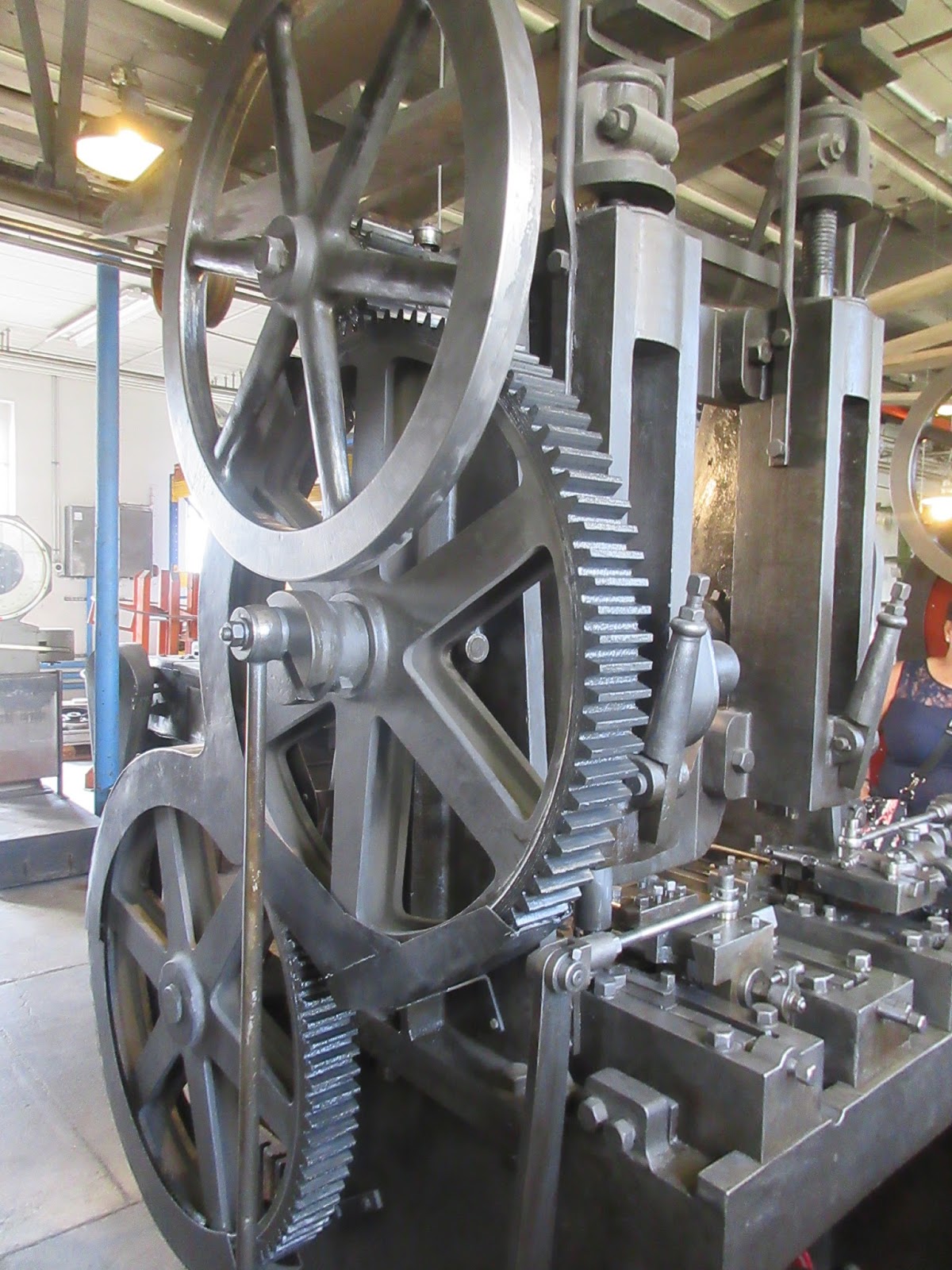
Friday 29 July 2016 was the date set aside for a summer event by ZIWA's Discovering Zurich and Switzerland group. Winterthur is well known for its industrial heritage, as ZIWA members know well from previous visits to the town, but today's trip was slightly more quirky than before. Twelve ladies took the train one step beyond to Winterthur Grueze where we were met by our guide for the morning, industrial archaeologist Dr. Hans-Peter Baertschi, who led us back in time to 1895. Behind the factory door, we were surprised to uncover an active workshop with the original machinery for making nails still in working order.


The northern town's industry dates back to the 19th century and before, when grain, rope, nails and textiles were processed or manufactured. Out of these raw materials, the production of clothing and the machinery to run the mills also evolved. It turned out the manufacture of machinery was more profitable, and hence Switzerland's first machine factory producing steam and diesel engines was located here. In the first half of the 19th century, there were seven railway lines providing transport in the north of the country from Lac Leman to the Bodensee. However, the railway company went bankrupt in 1877, and the town switched over to producing consumer goods and farm produce. The late 20th century saw the decline of the last major Swiss brewery, Haldengut, which was taken over by Heineken ten years ago. So Winterthur's industrial heritage has now all but vanished.


However, at the show workshop in Grueze, thanks to Dr Baertschi, a working nail factory has been lovingly maintained and is run as a family business which employs ten people, two of them women. At the old plant using the original machinery, we saw nails, screws and staples being made. These high quality products are sold to a specialist market and are also used in the production of window fasteners and in railway sleepers and telegraph poles. The raw material comes from the Saar region of Germany, but the end product is sold to the hobby market, using its own on-site packaging materials. On our tour, we saw a machine stamping out the nail heads, wire being transformed into small nails, and other old machinery including  an anvil and smithy. At the factory museum, there was a display of Winterthur's historic products as well as books and postcards on display.


After this step back in time, the group returned to the modern town centre for lunch before the return journey. Thanks to Rowena Woollard for finding this hidden gem.

Julia Newton, 31 July 2016.


Tuesday, 16 June 2015

Discovering Neuchatel

On Thursday 11 June 2015, 15 members of ZIWA's Discovering Zurich and Switzerland group visited this charming town in the French part of Switzerland. After meeting at Zurich's main station we found our reserved seats on the train to Biel. Anne-Marie, our chairlady, had taken care of all the details for us. From Biel, we took a local train to Neuchatel, a city on the shores of the lake of the same name. Lake Neuchatel is the largest lake completely within Switzerland, we learnt from our guide, Veronique, who met us at the train station. She led us up and down on a fascinating walking tour, culminating in lunch in the market square. Always a great way to end a ZIWA tour!

First we walked down steps to the newer part of the town and learnt about the 18th and 19 century architecture. Many fine buildings had been built in the local yellow sandstone, which French writer Dumas described as being carved out of butter. Maximilian de Moreau and Alexandre du Peyrou were responsible for two of the private houses with nicely laid-out gardens. We noted that the original lakeside receded due to water management in the Rhine, and a harbour was not built until 1840.

We were then able to visit inside the city hall, which was undergoing renovation. This building owes its existence to David de Purry (or Pury) who came from a wealthy family and also founded a poorhouse and hospital. We saw a fascinating model of the city as it was at the end of the 18th century. After this, we again ascended up steps and a steep road to the castle and collegiate church. The latter was built in the 12th and 13th century but were unable to see inside due to a prior booking by a bank! We saw the castle from outside and discovered it has been restored in the 15th and 16th centuries after a fire. Inside the Council Hall we noted the shields of the founding families of the city.

Neuchatel was originally owned by the French from Burgundy and later by the Orleans-Longueville family.  It then became the property of the King of Prussia after 1707.  It joined the Swiss confederation in 1815 during the time of Napoleon, but eventually the canton became independent in 1848. Nowadays it is a watch and clock research centre and is in the centre of a wine area.

After this comprehensive tour from our very knowledgeable guide, we descended to the market place and saw the Thursday market in full swing. We had a lovely lunch on the terrace of Le Marche before taking the train back to Zurich. Many of the group however decided to take a slow boat back to Biel to prolong the pleasure of another ZIWA Discovering trip on a sunny June day.


Wednesday, 21 January 2015

Discovering Zurich’s historic tram museum


Another first for ZIWA’s intrepid Discovering Zurich & Switzerland group was Tuesday afternoon’s guided tour of the Tram Museum, housed in the old tram depot in Burgwies. Zürich is famous for its comprehensive tram network, but less well known is its history and the variety of trams in use over the past 130 years. After some elaborate negotiations at the cash desk, twenty ladies were admitted into the hall housing a tram collection dating back to 1882. There we were able to climb inside the cars varying in age from 1897 to 1968, as well as learning something of the history of the tram network. It was an afternoon well spent for the transport enthusiast.

Our guide Hans Ryffel knew everything about the old tram companies who each commissioned their own liveried tramcars in distinctive colours. The earliest trams were horse-drawn and the network supported as many as 200 horses at the end of the 19th century. In 1900 electric trams were introduced on the 1 metre gauge tram tracks still in use today. Early tram routes ran from Seefeld to the main station, and on to Paradeplatz and Enge; the Glattbrugg line ran through Oerlikon and went as far as the Rigibahn, and a tram line even ran across the Münsterbrücke. Eventually the private companies were taken over by the city and more inner city lines were built.

The tram museum contains working examples of all ages of the Zurich tram, all lovingly maintained by a Verein of volunteers. The city of Zurich owns the trams in the museum as they are also insured to travel on the city tram line: the Museum Line 21 runs every last weekend of the month. All the tram cars in service were built locally, some in the workshops in Schlieren.  The first electric trams had a driver and conductor and only ran one way, so a turning loop was built at the end of each line. Early trams also pulled trailers and even a post wagon. The trams were especially popular in winter, when people left their cars at home. Smoking used to be permissible in the trailer section of the tram. Articulated tramcars were constructed in 1966-68. The modern cobra tram has low entry for passengers but the space for machinery under the cars is reduced.

The trams are powered from overhead power lines which send up to 600 volts through the braker system to the controller.  Wet lines or leaves on the line can still be a problem today. At the tram museum, with a little imagination, one can still smell the oil and smoke and hear the sound of the horses’ hooves clopping along the tracks. For information about the Museum Line service as well as a guide to the tram museum, see this link: www.tram-museum.ch. You might even consider holding a party at the museum!

Thank you to Rowena for arranging the tour and to Anne-Marie for coordinating the afternoon visit.

Julia Newton, 21 January 2015.


Thursday, 5 September 2013

Discovering Appenzell and its colourful history


Wednesday 29 August, 2013

http://www.myswitzerland.com/en-ch/appenzell2.html

http://www.appenzell.info/en


One member came all the way from Melbourne to enjoy the rain
On one of the wettest days of the summer, 21 members of the ZIWA Discovering Zürich and Switzerland group travelled by train from Zürich via Gossau SG to the smallest cantonal capital of Switzerland’s smallest canton, Appenzell Innerrhoden. Heavy rain and our local guide Maria Inauen greeted us at the station. Umbrellas were the order of the day. The picturesque village of Appenzell now has around 5.500 inhabitants, and the canton has a mere 15,000 inhabitants living in an area of 172 square kilometres. The canton is divided into mountains, forest and farmland, and agriculture, tourism and handicrafts support the local economy. As we dodged the rain under a canopy of umbrellas, we learnt more about this historic town and its traditions. Some people had to seek out sensible shoes before they could relax and enjoy the tour.

Appenzell’s history and tradition

Paintings of local traditions are on sale in the local shops
The canton of Appenzell became independent from St. Gallen and was accepted into the Swiss confederation in 1513, and this year is celebrating its 500th anniversary. In 1560, a fire destroyed 170 wooden houses in the small town, and one person lost his life. Appenzell village was Catholic, but the Protestant canton of Zürich gave gold to help the recovery. In 1597, the canton divided into two half-cantons along religious lines, with Innerhoden (IR) being Catholic and Ausserrhoden (AR) Protestant. People were given the choice of where to settle but a strict divide was maintained. There are four nunneries in Innerrhoden, and today we stood outside one of them which had sadly closed its doors when the sisters of the Franciscan order were reduced in number to five. Pilgrims on the way to Santiago de Compostelo can still stay in the Appenzeller convent though.

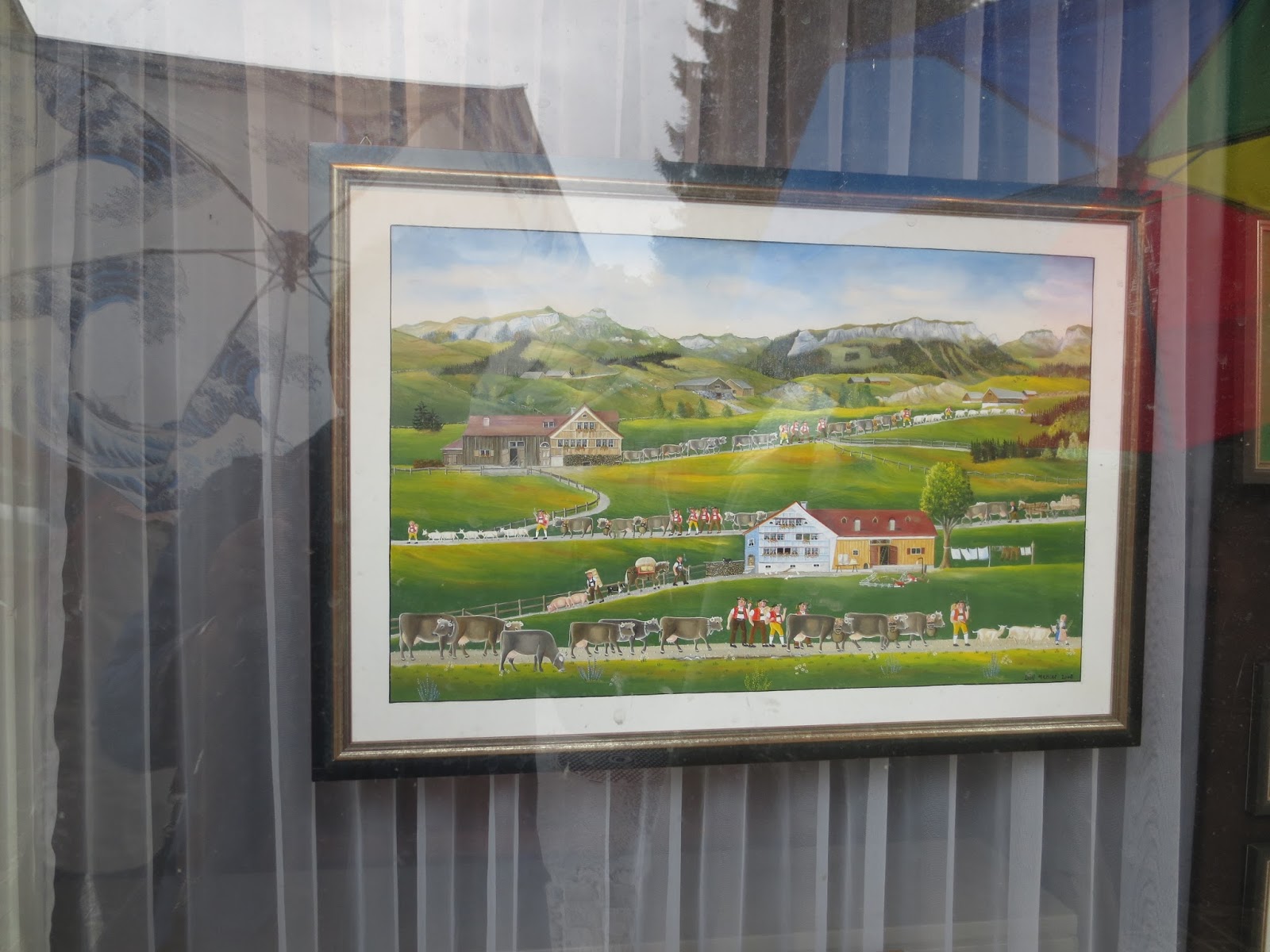
Next door in the Postplatz was a castle, or what goes for such in Switzerland, a once elegant family home built for the Löw family in 1563, with a turreted roof and an extensive garden. However the current owners, the Sutter family, have no children so its future is insecure. Across the road we saw one of many arts and crafts shops, this one selling works by local artist Mettler, who painted scenes of cows and the alpine parades. The festival of bringing the cows down from the high pasture at the end of summer, from mid-August to mid-September, is one of the most famous and colourful, something to see once at least during one’s stay in Switzerland. Several processions take place with a similar format with a leader, a man dressed in tight yellow trousers, the three cows bearing large heavy bells, and the white goats. The landscape of the Alpstein Mountains is a popular destination for hikers, and would be even lovelier on a dry day.

Life in Appenzell

The interior of the Catholic Church of St. Mauritius is ornate
Appenzell is famous for its cheese, and opposite the art shop we saw a yellow house which is the headquarters of the cheese producers. Beer is another famous local product, and we glimpsed the Quöllfrisch brewery near the fast-flowing River Sitter. The artist Dörig makes bells for the cows and also personal jewellery items; men’s single earrings are especially popular in Appenzell apparently.  It’s true that many local farmers are on the lookout for a prospective marital partner.

The tower of the Catholic Church survived the fire of 1560, and we noted the 1920 portrait of St. Moritz on the tower exterior; it caused some controversy at the time due to the saint’s bare legs. We took shelter in the church crypt, to learn more about the traditional costumes that are worn for the local parades and are often handed down – our guide Maria had a dress and headgear from her grandmother. Men wear red jackets and women have colourful skirts and headpieces which can take 360 hours to make. The colour of lace on the hat determines whether the wearer is single or married. Baptisms and meditation take place in the church crypt. Outside we viewed the cemetery which appeared to be very full; nowadays cremated relics are also scattered here on a smaller plot. The church interior is now very ornate, in the Baroque style seen in Einsiedeln, and we learnt that it originated in 1320, was rebuilt in 1488-1515, and was renovated again in 1823-28. Stained glass windows were given by donors. The high altar is not centrally located due to the hardness of the underlying Alpstein rock.
The pharmacy is suitably illustrated with herbs

Appenzell’s politics

Up the main street or Hauptgasse, we passed the brick-red 16th century Rathaus with its colourful flags, and noted the position of the Museum Appenzell on the floor above the adjacent tourist office, with its distinctive hanging sign. The building also contains original prison cells from the olden days. The buildings all along the Hauptgasse had been recently repainted on their facades in differing styles, by Johannes Hugentobler, who married the pharmacy owner’s daughter. We saw murals of flowers, geometric shapes and symbols as well as 35 different medicinal herbs.

At the top of the main street we reached the Landsgemeindeplatz where voting is conducted outdoors on the last Sunday in April. Elections are held for the local government, the high court officials and the representative to the Ständerat. 5000 people traditionally attend these occasions which are also popular with tourists. Voting is done by a show of hands unless it appears to be a close call, in which case there are two exits where voters are counted out. Men carry swords in the parade from the Town Hall to the main square; it was only in 1991 that women in Appenzell got the vote. Our resident guide hoped for a better future from now on!

After the informative tour, a lovely lunch was taken at the traditional Café-Hotel Appenzell before visiting the Museum Appenzell with its artefacts and photos of local history and the Liner Museum, which features traditional and contemporary artwork.

Julia Newton, 5 September 2013.