Showing posts with label history. Show all posts

Thursday, 5 September 2013

Discovering Appenzell and its colourful history


Wednesday 29 August, 2013

http://www.myswitzerland.com/en-ch/appenzell2.html

http://www.appenzell.info/en


One member came all the way from Melbourne to enjoy the rain
On one of the wettest days of the summer, 21 members of the ZIWA Discovering Zürich and Switzerland group travelled by train from Zürich via Gossau SG to the smallest cantonal capital of Switzerland’s smallest canton, Appenzell Innerrhoden. Heavy rain and our local guide Maria Inauen greeted us at the station. Umbrellas were the order of the day. The picturesque village of Appenzell now has around 5.500 inhabitants, and the canton has a mere 15,000 inhabitants living in an area of 172 square kilometres. The canton is divided into mountains, forest and farmland, and agriculture, tourism and handicrafts support the local economy. As we dodged the rain under a canopy of umbrellas, we learnt more about this historic town and its traditions. Some people had to seek out sensible shoes before they could relax and enjoy the tour.

Appenzell’s history and tradition

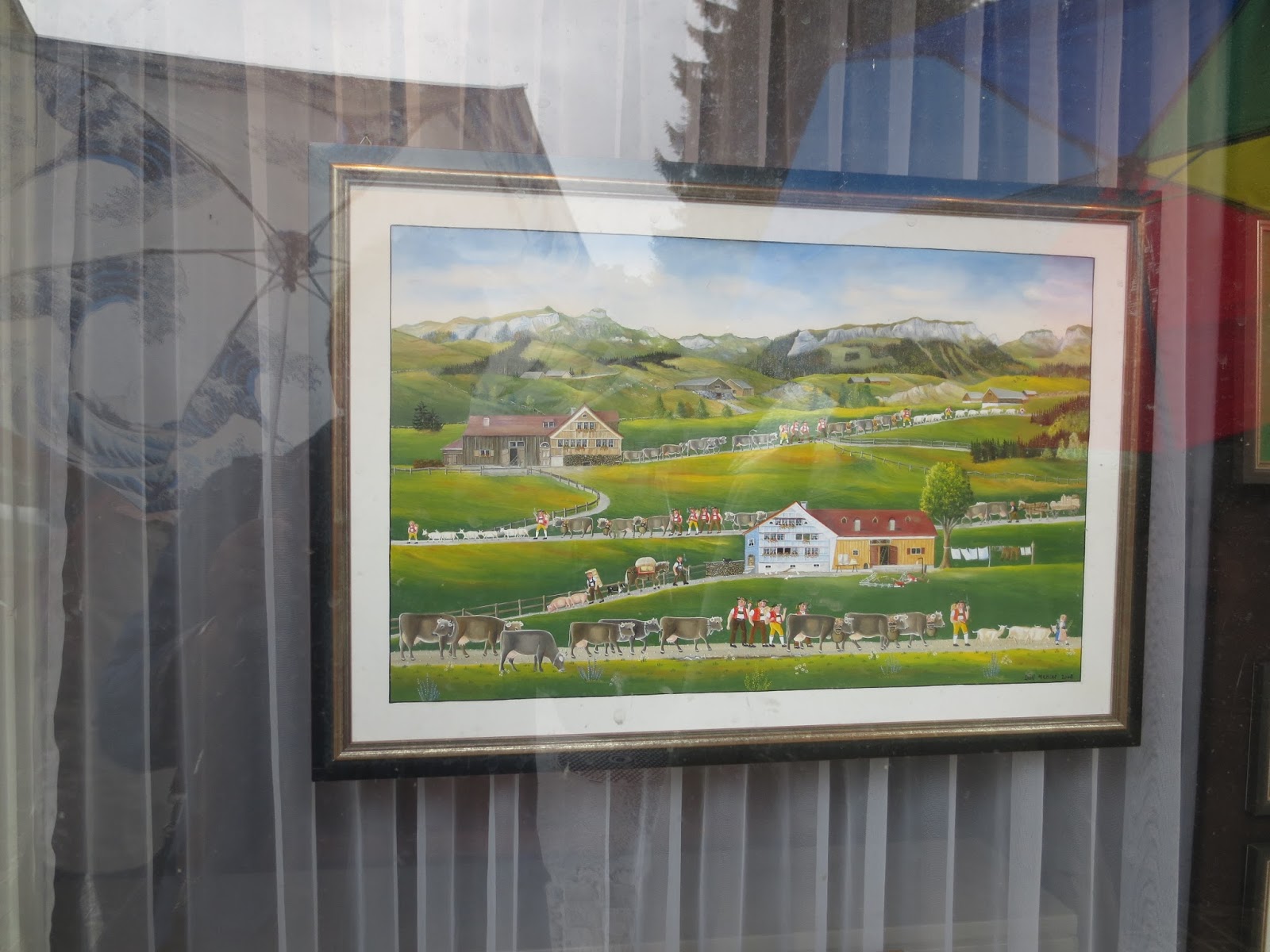
Paintings of local traditions are on sale in the local shops
The canton of Appenzell became independent from St. Gallen and was accepted into the Swiss confederation in 1513, and this year is celebrating its 500th anniversary. In 1560, a fire destroyed 170 wooden houses in the small town, and one person lost his life. Appenzell village was Catholic, but the Protestant canton of Zürich gave gold to help the recovery. In 1597, the canton divided into two half-cantons along religious lines, with Innerhoden (IR) being Catholic and Ausserrhoden (AR) Protestant. People were given the choice of where to settle but a strict divide was maintained. There are four nunneries in Innerrhoden, and today we stood outside one of them which had sadly closed its doors when the sisters of the Franciscan order were reduced in number to five. Pilgrims on the way to Santiago de Compostelo can still stay in the Appenzeller convent though.

Next door in the Postplatz was a castle, or what goes for such in Switzerland, a once elegant family home built for the Löw family in 1563, with a turreted roof and an extensive garden. However the current owners, the Sutter family, have no children so its future is insecure. Across the road we saw one of many arts and crafts shops, this one selling works by local artist Mettler, who painted scenes of cows and the alpine parades. The festival of bringing the cows down from the high pasture at the end of summer, from mid-August to mid-September, is one of the most famous and colourful, something to see once at least during one’s stay in Switzerland. Several processions take place with a similar format with a leader, a man dressed in tight yellow trousers, the three cows bearing large heavy bells, and the white goats. The landscape of the Alpstein Mountains is a popular destination for hikers, and would be even lovelier on a dry day.

Life in Appenzell

The interior of the Catholic Church of St. Mauritius is ornate
Appenzell is famous for its cheese, and opposite the art shop we saw a yellow house which is the headquarters of the cheese producers. Beer is another famous local product, and we glimpsed the Quöllfrisch brewery near the fast-flowing River Sitter. The artist Dörig makes bells for the cows and also personal jewellery items; men’s single earrings are especially popular in Appenzell apparently.  It’s true that many local farmers are on the lookout for a prospective marital partner.

The tower of the Catholic Church survived the fire of 1560, and we noted the 1920 portrait of St. Moritz on the tower exterior; it caused some controversy at the time due to the saint’s bare legs. We took shelter in the church crypt, to learn more about the traditional costumes that are worn for the local parades and are often handed down – our guide Maria had a dress and headgear from her grandmother. Men wear red jackets and women have colourful skirts and headpieces which can take 360 hours to make. The colour of lace on the hat determines whether the wearer is single or married. Baptisms and meditation take place in the church crypt. Outside we viewed the cemetery which appeared to be very full; nowadays cremated relics are also scattered here on a smaller plot. The church interior is now very ornate, in the Baroque style seen in Einsiedeln, and we learnt that it originated in 1320, was rebuilt in 1488-1515, and was renovated again in 1823-28. Stained glass windows were given by donors. The high altar is not centrally located due to the hardness of the underlying Alpstein rock.
The pharmacy is suitably illustrated with herbs

Appenzell’s politics

Up the main street or Hauptgasse, we passed the brick-red 16th century Rathaus with its colourful flags, and noted the position of the Museum Appenzell on the floor above the adjacent tourist office, with its distinctive hanging sign. The building also contains original prison cells from the olden days. The buildings all along the Hauptgasse had been recently repainted on their facades in differing styles, by Johannes Hugentobler, who married the pharmacy owner’s daughter. We saw murals of flowers, geometric shapes and symbols as well as 35 different medicinal herbs.

At the top of the main street we reached the Landsgemeindeplatz where voting is conducted outdoors on the last Sunday in April. Elections are held for the local government, the high court officials and the representative to the Ständerat. 5000 people traditionally attend these occasions which are also popular with tourists. Voting is done by a show of hands unless it appears to be a close call, in which case there are two exits where voters are counted out. Men carry swords in the parade from the Town Hall to the main square; it was only in 1991 that women in Appenzell got the vote. Our resident guide hoped for a better future from now on!

After the informative tour, a lovely lunch was taken at the traditional Café-Hotel Appenzell before visiting the Museum Appenzell with its artefacts and photos of local history and the Liner Museum, which features traditional and contemporary artwork.

Julia Newton, 5 September 2013.


Thursday, 31 May 2012

Discovering Murten - history comes to life

I first discovered the small medieval city of Murten last year, thanks to fellow ZIWA member Amy Eber who also found the place by chance, and loved it so much she and her husband took an apartment there, right in the middle of the medieval town centre. The Discovering Zürich & Switzerland group had a guided tour there last week, and learnt more about its history and present-day culture. If you’ve never been, make a point to visit this summer. It can be reached by train via Bern or Neuchatel, or you can take a boat trip on the Drei-Seen-Fahrt from Biel via the lake of Neuchatel to the Murtensee.

Our guide to Murten was Beatrice Magnin-Riedi, a bilingual French/German speaker who also spoke perfect English, whom we met at the small castle just inside the city walls. The view over the Murtensee was splendid, although clouds obscured the mountain of Vully and the wine terraces until later in the day. The Romans passed through here as did the Helvetii, and the town is one of several surrounding and protecting the city of Bern. German and French are taught in schools and we learnt that the University of Fribourg in the cantonal capital hold all its courses in both languages.  The city of Murten was established in 1238, and Peter of Savoy conquered it in 1255; the Savoyards ruled until 1476 when the Battle of Murten took place. Savoy is unusual in having had several women leaders and there is still a predominance of women working in the court building opposite the castle, and there has also been a recent tradition of women presidents in the Gemeinde, a fact that struck a chord with our women’s group.

Murten has retained its medieval buildings, even though cars clutter the cobbled streets of the centre, and the town holds many traditional festivals. One of these is the ‘slow up’ 20 km. walk around the lake every October. There is a carnival in March, flea markets in June, the ‘Solennität’ youth festival commemorating the Battle of Murten, and a Christmas market. There are no electric street lights in the town and the old coats of arms and shop signs have been retained everywhere.  There is a grid of old streets with alleyways or Graben in between, where the fire service had access and rubbish used to be thrown out. Overshoes were de rigeur in those days. The reformer Calvin had 30 people burnt on account of the plague in the 16th century.  The witch tower still exists where women suspected of being too clever or having moles on their skin were tortured and beheaded or burnt. Nowadays as then the cellars and ground floors could be used for business while the upper floors were residential.

It is also possible to climb up onto the city wall and see the view over the rooftops, with their distinctive tiles. Outside the walls, the Catholic church of St. Mauritius is located, and inside it we discovered very modern stain glass windows designed by a local artist in 1977. Murten today thrives from four types of business – tourism, local shops and crafts, small industry and farming.  One curiosity is the former clock from the old city hall which has been restored to its former design and chimes the quarter hours and the hours. In the arcaded shops reminiscent of Bern one can buy local products including the famous Nidelkuchen.


There are numerous restaurants and cafes in Murten where one can enjoy lunch inside or out. We chose the Murtenhof, with its terrace overlooking the lake, and afterwards walked down to the boat landing stage to take the boat across the lake of Murten. On sunny days it’s very pleasant to take a picnic beside the lake and enjoy the water sports. The boat to Biel crosses the Murtensee and glides through the Broye canal to the Lake of Neuchatel. The sun shone on us for this pleasant journey and from there, after a steep climb to the station, the direct train takes you back to Zurich.

Murten Tourist Office links: 
The Solenittat festival:
Julia Newton, 31 May 2012