Thursday, 15 October 2015

Wine discovery - Asian Food and Suggested Wines

http://www.janefinefood.com/en/

ZIWA's Wine Discovery group always offers pleasurable experiences. And yesterday's visit to old friend Jane's Fine Foods was very popular. Fourteen group members, including one husband, had the chance to sample six freshly-cooked fusion dishes and try a wine suggestion to complement the spicy food. Many people pair spicy food with beer, but a carefully chosen wine could bring out the flavour of both food and wine.

Coconut milk potato gratin and Riesling

The white wine was a sharp, citrussy dry Riesling from Langenlonsheim in the Nahe/Rhine Valley area of Germany. The Tesch 2013 wine would be  suitable as an apero wine on its own, but the spicy potato gratin dish with green curry paste enhanced it even more. Jane mentioned that the potato dish was one of her favourites and could also accompany meat or seafood dishes.

Here's the link to the Tesch website: http://www.weingut-tesch.de/

Peanut satay sauce with Pine Ridge Viognier/Chenin Blanc

The satay sauce was made by heating peanut butter and coconut milk, diluted with water if necessary, with red curry paste flavoured with garlic, chilli and ginger. It was served with vegetable crudites. The Californian white wine was a 2013 blend of Viognier and Chenin Blanc grape types from Pine Ridge vineyards and would be just as good drunk on its own. It had complex notes reflecting the grape types and the mineral soil of the terroir.

Here's the link to the Pine Ridge website: http://www.pineridgevineyards.com/

Grilled prawns with Zweifel Spätlese 

The frozen prawns had been defrosted and marinaded for half an hour in a chilli and garlic marinade with cumin. Jane grilled the prawns in a herby rapeseed oil and then served immediately. Complementing the seafood was a Zurichsee Spätlese 2013 white wine, Vidal Blanc. It had a rather sweet taste.

Here's the Zweifel Hürlimann wine shop link: http://www.zweifelweine.ch/thewineshop_aktuell.cfm
Zweifel is a great source of many wines.

Crab salad with Fusion Gewürztraminer

The crab was obtained frozen, and was served in small portions on a green salad, and tasted spicy and slightly salty. It could also be served with sushi ginger. The dressing was made from rice vinegar, soy sauce, lime and lemon juice and palm sugar. The accompanying wine this time was a Viognier/ Gewürztraminer blend from Fusion wines in California.

You can see the wine at this link: https://www.vivino.com/wineries/us-fusion/wines/viognier-gewrztraminer-9999

Coconut milk soup with Sebastiani Rose
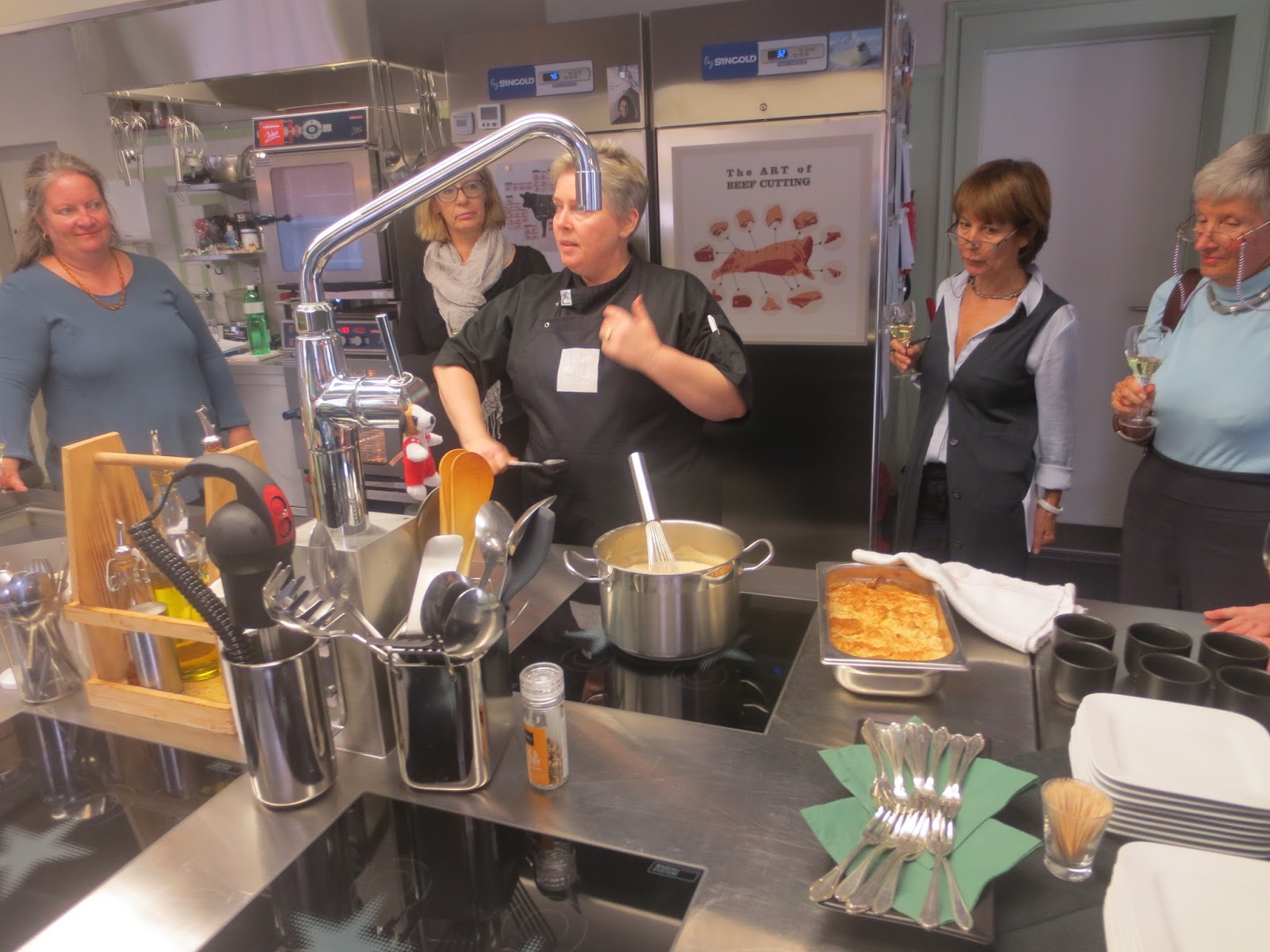
Jane uses this soup mix as the basis for many dishes. It was flavoured with lemongrass, shallot, red curry paste and based on coconut milk from a tetrapack. A rose wine from Sebastiani in California this time went well and gave a kick.

See more about the wine here: http://www.sebastiani.com/

Beef teriyaki and Conundrum red wine

Jane buys her beef fillet from a butcher who supplies quality Australian meat. It was chopped into thin slices and marinaded in Thai sweet chilli sauce with soy and ginger, before frying. Salt should only be added at the last minute. The beef demanded a red wine, another Californian blend, the Conundrum 2012, which was served cool.

Here's the Conundrum website: http://www.conundrumwines.com/

Thanks to Jane for sharing her kitchen, her food and her expertise. A great sharing experience. Cheers!

Julia Newton, 15 October 2015.


Saturday, 12 September 2015

Discovering the underground world of Sasso San Gottardo


Last Tuesday, 8 September a group of 14 ZIWA Discoverers set off on one of the most unexpected discoveries yet: a journey inside the Alps into a secret underground world which until recently was unavailable to members of the public. We visited the fortress of Sasso San Gottardo, a warren of tunnels and rooms built to provide wartime security in case of attack. Rowena Woollard was the instigator of this fascinating journey.

The day trip started in Zurich with the train to Arth Goldau via Zug, where some on the group members joined the tour. On the connecting train from Arth-Goldau to Airolo via the Gotthard rail tunnel, we had to fight for our seats with three other groups in our reserved carriage. But all was well and we arrived in time to catch the post bus to the Gottard- Passhöhe, at an altitude of 2091 metres. Overnight the temperature had caused the museum toilets to freeze, so we were relieved to find a cosy cafeteria inside the bleak mountains. Our guide Marina was happy to serve us coffee and gipfeli while we waited to use the single convenience!

A mountain retreat

Then we were kitted out and ready to take the 500 metre walk through a damp, cold tunnel into the heart of the fortress, known as the Swiss Redoubt. Snug fleeces were the order of the day. At the end of this tunnel we climbed aboard a tiny train to lift us up to the accommodation level where 480 soldiers could be housed. But why bring anyone into this dark, secret world? General Guisan, Switzerland’s wartime army commander, wanted to build not one but 67 such fortresses to provide a safe retreat from the Italian and German forces surrounding the country. The topography of this particular location was suitable strategically and was well protected. But workers were hard to find and keep, and the project took from 1941 to 1945 to complete, by which time the war was over.

Inside the fortress

We saw the Firing Control Centre where calculations were made to determine the angle and range of the projected cannon fire. Four artillery guns were directed through the rock at two angles towards Italy. The soldiers would be shooting blind from within so the calculations had to be accurate. Observers on the outside were in contact by telephone.

We saw a movie, ‘Sasso da Pigna’, about the construction of this twilight world. When Germany invaded Belgium and Holland in 1940, and then France capitulated, Switzerland felt extremely vulnerable. The Alpine passes had to be maintained to allow transport of needed coal and arms. In July 1940, Guisan decided on the redoubt plan which was announced at Rütli in August 1940. He started to build three fortresses inside the Gotthard. The one we visited was facing towards the San Giacomo Pass on the Italian side. The work took four years to complete and cost CHF 900 million.

Still a well-kept secret

In 1944, the threat receded, troops were sent to guard the borders and no more building was done after 1946. During the Cold War, the redoubt became out-dated, but the myth persisted. The underground warren containing dormitories, showers and officer quarters, was used by soldiers on training exercises. On a balcony outside, we could see the cannons poking through the blind rock face. We also saw a small museum with artefacts saved from the war years, including unusual mementoes of General Guisan, the Swiss wartime hero. We also saw the secret plans, which a traitor copied and was later shot.

Lunch in another surprising tunnel!

After viewing more of the warren of tunnels in the fortress, we saw an exhibition of huge, clear crystals brought up from the mining. Then we emerged into daylight briefly to descend to an adjacent tunnel into our lunch venue at La Claustra, a unique hotel complex underground.

Fourteen lucky ZIWA ladies enjoyed an apero and four-course lunch in Ristorante Tremola, delivered to us by our genial host, Rainer Geissmann. Afterwards he very kindly deliver us one by one to the bus stop in his sports car; just in time for the descent via Andermatt to Göschenen and hence Zurich. Unfortunately the SBB service that afternoon was compromised by a broken down train outside Bellizona so the return journey took rather longer than anticipated. However it didn't detract in any way from the fabulous experience.

You can discover more about La Claustra, which is also a hotel, on Facebook.

Julia Newton. 12 September 2015


Wednesday, 22 July 2015

ZIWA Kunsthaus event - July 2015

Europe – The Future of History is the title of a new exhibition at Zurich’s Kunsthaus. Curator Catherine Hug asks, ‘What image represents Europe today?’ She has drawn together an eclectic collection of visual and digital images from the 20th and 21st centuries. On Wednesday, 8 July 2015, ZIWA members had the privilege of a guided tour of some of the 100 art works in the main first floor exhibition gallery. Catherine and her colleague Anna Bähler took us round the show in two groups of 20. It certainly helped our understanding to discover how this collection was selected and what it signified.

The exhibits ranged from Valloton’s The Rape of Europa (1908), a mythological painting in oil on canvas, to an installation of pallets which turned out to be made from polyurethane and not wood. We could enjoy viewing a collection by Dani Gal of record sleeves of famous speeches on vinyl and a series of portrait photos of famous people who have visited Café Odeon in Zurich’s Limmatquai.  A living artist from Geneva had painted a Histoire de Bretagne on the gallery wall while a collection of Breton faience signified the importance of tradition. The Austrian artist Herbert Brandl had created a montage of web images as the basis of his artwork showing the protection of the landscape, while Italian artist Boetti had created a world map in embroidery from a Euro-centric viewpoint.

The reunification of Germany and the destruction of the Berlin Wall were poignant images evoked by a German artist, and another series of painting depicted intimate views of different living spaces. Max Ernst, the German Surrealist, had fashioned another view entitled Europe after the Rain (1933), while another satirical German, Otto Dix, depicted a view of Switzerland from the German side of the Bodensee. There was even a chance to discover the different versions of blue fabric which are used to create the flag of the European Union.


After the one-hour tour which posed many questions about what Europe signifies to us, the ZIWA group convened on the restaurant terrace for an apero arranged by new Events Director Sarah da Ponte. The two guides joined us to answer more of our questions. This exhibition would repay a second visit in order to experience the full selection of art works while perhaps allowing one to speculate on what we would have chosen.


You can read more about this special exhibition at this link: http://www.kunsthaus.ch/en/exhibitions/

ZIWA is an international group comprising many European and international members with diverse mother tongues and home countries. What would your enduring image of modern Europe be?


Julia Newton, 22 July 2015.

Tuesday, 16 June 2015

Discovering Neuchatel

On Thursday 11 June 2015, 15 members of ZIWA's Discovering Zurich and Switzerland group visited this charming town in the French part of Switzerland. After meeting at Zurich's main station we found our reserved seats on the train to Biel. Anne-Marie, our chairlady, had taken care of all the details for us. From Biel, we took a local train to Neuchatel, a city on the shores of the lake of the same name. Lake Neuchatel is the largest lake completely within Switzerland, we learnt from our guide, Veronique, who met us at the train station. She led us up and down on a fascinating walking tour, culminating in lunch in the market square. Always a great way to end a ZIWA tour!

First we walked down steps to the newer part of the town and learnt about the 18th and 19 century architecture. Many fine buildings had been built in the local yellow sandstone, which French writer Dumas described as being carved out of butter. Maximilian de Moreau and Alexandre du Peyrou were responsible for two of the private houses with nicely laid-out gardens. We noted that the original lakeside receded due to water management in the Rhine, and a harbour was not built until 1840.

We were then able to visit inside the city hall, which was undergoing renovation. This building owes its existence to David de Purry (or Pury) who came from a wealthy family and also founded a poorhouse and hospital. We saw a fascinating model of the city as it was at the end of the 18th century. After this, we again ascended up steps and a steep road to the castle and collegiate church. The latter was built in the 12th and 13th century but were unable to see inside due to a prior booking by a bank! We saw the castle from outside and discovered it has been restored in the 15th and 16th centuries after a fire. Inside the Council Hall we noted the shields of the founding families of the city.

Neuchatel was originally owned by the French from Burgundy and later by the Orleans-Longueville family.  It then became the property of the King of Prussia after 1707.  It joined the Swiss confederation in 1815 during the time of Napoleon, but eventually the canton became independent in 1848. Nowadays it is a watch and clock research centre and is in the centre of a wine area.

After this comprehensive tour from our very knowledgeable guide, we descended to the market place and saw the Thursday market in full swing. We had a lovely lunch on the terrace of Le Marche before taking the train back to Zurich. Many of the group however decided to take a slow boat back to Biel to prolong the pleasure of another ZIWA Discovering trip on a sunny June day.


Wednesday, 29 April 2015

Restaurant of the Month - April 2015

Restaurant Blaue Ente, Muehle Tiefenbrunnen, Seefeldstrasse 223, 8008 Zurich.

http://blaue-ente.muehle-tiefenbrunnen.ch/

For our last outing with the ZIWA Dining Around the World group, we met for lunch at the Restaurant Blaue Ente at Zurich Tiefenbrunnen. The journey there from the main station takes 15 minutes by tram and it is located in the courtyard of the Muehle, next to Miller's Studio and the Muehlerama Museum. Sadly it was too wet yesterday to sit outside on the attractive terrace, but inside the restaurant is spacious and features an old mill wheel. Our group of ten ladies received excellent service and we all opted for one of the daily menu choices.


Today's selection featured either a mixed salad or carrot and ginger soup, which was delicious, followed by crispy cod with chervil on a bed of seasonal asparagus and a carrot couli, which most people opted for. We could also choose beef stroganoff with spaetzli or taglierini pasta with chilli. It was all freshly cooked, served hot and tasted delicious. Some of us opted to share a bottle of Austrian Weissburgunder wine, and even splashed out on a second bottle. Drinks and coffee were extra, and bread and a choice of waters were already on the table. The menu cost between CHF 23 for the pasta option to CHF32 for the beef; the fish menu cost CHF27.

Service was very attentive and the restaurant was pleasantly full but spacious. On a fine day it is very pleasant to linger on the terrace, There is also a bistro serving coffee and baked goods, taking advantage of the neighbouring mill museum which produces and sells bread, muesli and other bakery products. The pasta served in the Blaue Ente is the hand made Costa D'Oro brand made locally. And on Friday evenings there is live music in the piano bar.

Have a look at the website link above for all the options and to reserve. It's worth taking the time to find the Blaue Ente for its character, service and delicious food and wine.

Viel vergnuegen! 

Saturday, 25 April 2015

Visiting Jura World of Coffee

http://www.juraworld.com/

On Thursday 23 April 2015, ZIWA's Swinging Sixties group took a train journey into Canton Solothurn to visit the new Jura World of Coffee. We could almost smell the coffee as we got off the train in Oberbuchsiten and walked across a country field to the splendid, newly-appointed visitor centre. Our visit was master-minded as usual by chairlady Vreni Riedler, who had everything under control.

The art of coffee tasting

At the impressive exhibition centre, we were welcomed by our chief guide, Kristin Seidler, and we enjoyed a welcome cup of coffee and a gipfeli in the coffee lounge. Then we split up into two groups, one English-speaking and one German-speaking. The English group went first for a coffee tasting, led by Claudette who had laid out a counter with individual places for us to cleanse our palates before tasting two brands of coffee. We heard about the four taste types - sweet, sour, salty and bitter, and the many more aromas, around 10,000, which can be discerned by the nose.We sipped water flavoured with nutmeg and clove, and then we discovered that while holding our nose, it was harder to discern the identity of two more sample tastes, which turned out to be sugar and cinnamon. We also noted the different textures on the tongue of still and sparkling waters and creamy milk. After training our nose and mouth, we then tried the smell and taste of two different coffees, which came from the coffee machine with a deep head of foam or crema. Our first sample was Malabar Monsooned Indian coffee which had low acidity and tasted bitter and earthy. The second sample originated from San Antonio, Honduras and appeared darker but tasted less strong than the Indian coffee. Both types were one hundred percent Arabica beans.


Then we tried another taste test, this time sampling drinks of almond-flavoured amaretto and grape juice, both with distinctive flavours, but when mixed together, resulted in a new cherry flavour. We also learnt that the optimum water temperature for making espresso coffee is 65-68 degrees C. No more boiling water then, as I tend to prefer.

The history of coffee

The second part of the Jura coffee experience was an interactive tour through the history of coffee, leading us through a series of rooms with lighting and sound exhibits. Coffee had its origins in 9th century Ethiopia, when legend has it that a goatherd discovered that his goats became excitable when chewing the red coffee beans, which were made into a pulp and then a drink by a local monk.  The beans were, and still are, hand picked and dried in the sun before being roasted. Coffee is the world's second most important commodity after oil. The drink was then established in popularity in the Arabian peninsula in around 1100 and was sold in the souks.

At the end of the 16th century, Europeans brought the coffee trade to Venice. In 1578, German botanist Leonhard Rauwolf was the first European to bring the taste of coffee to Europe, where it soon became very popular as a drink. In 1615, the famous Cafe Florian was opened in Venice and helped to popularise the drink as a stimulant. Attempts by the Dutch to grow coffee failed however, so coffee plantations were established in the French colonies in Central America, where its cultivation was successful. The first coffee house opened in Vienna in 1683; later the idea caught on in London too. The Boston Tea Party in 1773 was the trigger for the Americans to develop a craze for coffee and they are now the world's biggest consumers.

In the 1930s, Leo Henzirohs, an inventor from Solothurn, developed the world's first electric coffee pot, and the Jura company has gone on to manufacture the ever more sophisticated coffee machines that we have today.


In heaven

After the fascinating history lesson, we watched a film entitled In Heaven, showing the popularity of coffee drinking all round the world. We also discovered that we could buy a variety of coffee beans and the latest in Jura coffee machines in the product shops. And as a final touch, we could meet brand ambassador Roger Federer and even have a photo taken with the great man in his walk of fame. Several people were keen to get in the picture with Roger.

After the eye-opening coffee tour, we walked to nearby Gasthof Sonne for a pre-ordered set lunch and a chance to relive the coffee experience with friends, before making the journey back to Zurich by bus and train. A big thanks goes to Vreni for another great day out.

Julia Newton, 25 April 2015.

Wednesday, 1 April 2015

Restaurant of the Month - March 2015

Restaurant Helvetia, Stauffacherquai 1, 8004 Zurich. 

http://www.hotel-helvetia.ch/de/node/2

This smart and popular lunch venue is located right next to the River Sihl at Stauffacher in Central Zurich. It's been recently renovated along with the bar downstairs and the integral hotel. The first floor dining room has views over the river and the city and is popular with business people meeting for lunch. This week, the ZIWA Dining Around the World group took a table for 10.

We had a table with banquettes on one side and chairs facing us. The waiter was very attentive to our arrivals and brought water immediately! Every lunchtime there is a Mittagsmenu selection of around five options with two starters and a choice of main courses costing between  CHF 24 and 33. Dessert, coffee and wine are extra.

Yesterday we chose between a salad and pepper cream soup. The soup could have been hotter but tasted good. The main course choices included salmon, beef stroganoff and some Swiss specialities. Last time I ate here, I could opt for a delicious corn-fed chicken and on another day you could choose pork. There is always a vegetarian option as well. Everyone was happy with the selection on offer but one or two of us felt that the plates were not hot enough. The waiter was happy to change them.

Several people opted for the house red wine and there is a daily wine suggestion at around CHF 8 per glass. The restaurant was full and is not very large, so you always need to book. Downstairs in the bar, snacks are also available. The a la carte menu has a small but good choice of dishes to suit all tastes at around CHF 40-50. The style is Swiss and international cuisine.

If you are looking for a smart but reasonably priced lunch in a convenient location with attentive service, this could be the place for you. Make sure to reserve and arrive early.

En guete!