Thursday, 5 September 2013

Discovering Appenzell and its colourful history


Wednesday 29 August, 2013

http://www.myswitzerland.com/en-ch/appenzell2.html

http://www.appenzell.info/en


One member came all the way from Melbourne to enjoy the rain
On one of the wettest days of the summer, 21 members of the ZIWA Discovering Zürich and Switzerland group travelled by train from Zürich via Gossau SG to the smallest cantonal capital of Switzerland’s smallest canton, Appenzell Innerrhoden. Heavy rain and our local guide Maria Inauen greeted us at the station. Umbrellas were the order of the day. The picturesque village of Appenzell now has around 5.500 inhabitants, and the canton has a mere 15,000 inhabitants living in an area of 172 square kilometres. The canton is divided into mountains, forest and farmland, and agriculture, tourism and handicrafts support the local economy. As we dodged the rain under a canopy of umbrellas, we learnt more about this historic town and its traditions. Some people had to seek out sensible shoes before they could relax and enjoy the tour.

Appenzell’s history and tradition

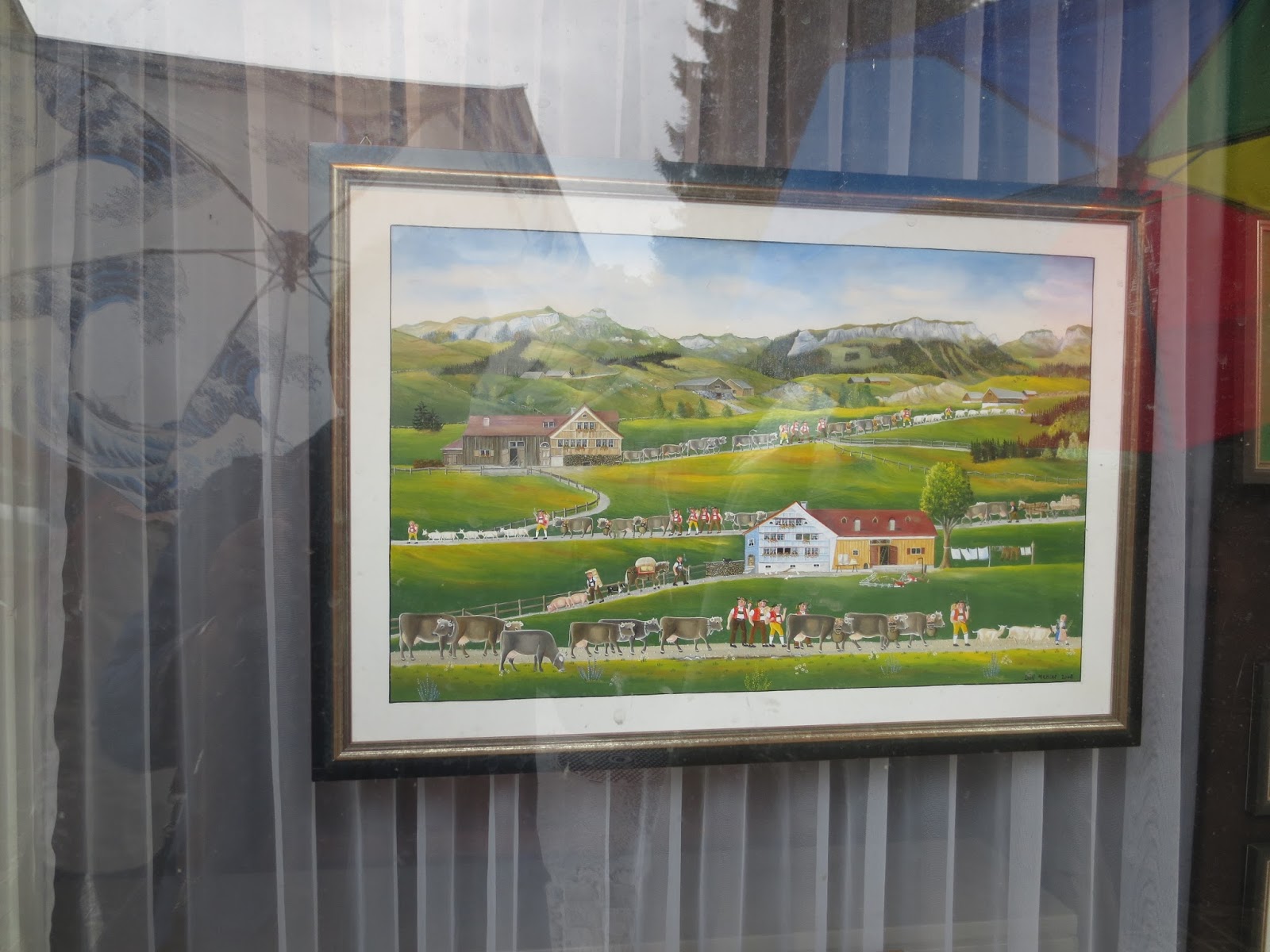
Paintings of local traditions are on sale in the local shops
The canton of Appenzell became independent from St. Gallen and was accepted into the Swiss confederation in 1513, and this year is celebrating its 500th anniversary. In 1560, a fire destroyed 170 wooden houses in the small town, and one person lost his life. Appenzell village was Catholic, but the Protestant canton of Zürich gave gold to help the recovery. In 1597, the canton divided into two half-cantons along religious lines, with Innerhoden (IR) being Catholic and Ausserrhoden (AR) Protestant. People were given the choice of where to settle but a strict divide was maintained. There are four nunneries in Innerrhoden, and today we stood outside one of them which had sadly closed its doors when the sisters of the Franciscan order were reduced in number to five. Pilgrims on the way to Santiago de Compostelo can still stay in the Appenzeller convent though.

Next door in the Postplatz was a castle, or what goes for such in Switzerland, a once elegant family home built for the Löw family in 1563, with a turreted roof and an extensive garden. However the current owners, the Sutter family, have no children so its future is insecure. Across the road we saw one of many arts and crafts shops, this one selling works by local artist Mettler, who painted scenes of cows and the alpine parades. The festival of bringing the cows down from the high pasture at the end of summer, from mid-August to mid-September, is one of the most famous and colourful, something to see once at least during one’s stay in Switzerland. Several processions take place with a similar format with a leader, a man dressed in tight yellow trousers, the three cows bearing large heavy bells, and the white goats. The landscape of the Alpstein Mountains is a popular destination for hikers, and would be even lovelier on a dry day.

Life in Appenzell

The interior of the Catholic Church of St. Mauritius is ornate
Appenzell is famous for its cheese, and opposite the art shop we saw a yellow house which is the headquarters of the cheese producers. Beer is another famous local product, and we glimpsed the Quöllfrisch brewery near the fast-flowing River Sitter. The artist Dörig makes bells for the cows and also personal jewellery items; men’s single earrings are especially popular in Appenzell apparently.  It’s true that many local farmers are on the lookout for a prospective marital partner.

The tower of the Catholic Church survived the fire of 1560, and we noted the 1920 portrait of St. Moritz on the tower exterior; it caused some controversy at the time due to the saint’s bare legs. We took shelter in the church crypt, to learn more about the traditional costumes that are worn for the local parades and are often handed down – our guide Maria had a dress and headgear from her grandmother. Men wear red jackets and women have colourful skirts and headpieces which can take 360 hours to make. The colour of lace on the hat determines whether the wearer is single or married. Baptisms and meditation take place in the church crypt. Outside we viewed the cemetery which appeared to be very full; nowadays cremated relics are also scattered here on a smaller plot. The church interior is now very ornate, in the Baroque style seen in Einsiedeln, and we learnt that it originated in 1320, was rebuilt in 1488-1515, and was renovated again in 1823-28. Stained glass windows were given by donors. The high altar is not centrally located due to the hardness of the underlying Alpstein rock.
The pharmacy is suitably illustrated with herbs

Appenzell’s politics

Up the main street or Hauptgasse, we passed the brick-red 16th century Rathaus with its colourful flags, and noted the position of the Museum Appenzell on the floor above the adjacent tourist office, with its distinctive hanging sign. The building also contains original prison cells from the olden days. The buildings all along the Hauptgasse had been recently repainted on their facades in differing styles, by Johannes Hugentobler, who married the pharmacy owner’s daughter. We saw murals of flowers, geometric shapes and symbols as well as 35 different medicinal herbs.

At the top of the main street we reached the Landsgemeindeplatz where voting is conducted outdoors on the last Sunday in April. Elections are held for the local government, the high court officials and the representative to the Ständerat. 5000 people traditionally attend these occasions which are also popular with tourists. Voting is done by a show of hands unless it appears to be a close call, in which case there are two exits where voters are counted out. Men carry swords in the parade from the Town Hall to the main square; it was only in 1991 that women in Appenzell got the vote. Our resident guide hoped for a better future from now on!

After the informative tour, a lovely lunch was taken at the traditional Café-Hotel Appenzell before visiting the Museum Appenzell with its artefacts and photos of local history and the Liner Museum, which features traditional and contemporary artwork.

Julia Newton, 5 September 2013.


Monday, 2 September 2013

Restaurant of the Month - August 2013

Restaurant Seerose, Seestrasse 493, 8038 Zurich-Wollishofen


While the summer weather is still warm and sunny, it's wonderful to eat lunch beside the beautiful lake of Zurich. At the end of the month, it was rather cool to sit outside, but the Seerose has an open indoor dining area very close to the water's edge. Our waitress was friendly and helpful, and we perused the menus for special lunch options and the a la carte choices. One of the quirks of this upmarket place is the handwritten day's specials, which are rather challenging to read. But we could choose from two starter and two main course options at a reasonable price of CHF 31.50: spicy cauliflower soup or beef tartare bruschetta, followed by prawns with potatoes and morels or lamb escalopes with tagliatelli and a delicious sauce. Someone in our friendly ZIWA Dining Around the World group also opted for the 'anti-ageing menu' of salmon and summer vegetables which looked delicious as well as healthy.

For wine enthusiasts it was possible to try out a choice of two whites - a Gruner Veltliner and a Pinot Grigio - before opting for one, in this case the Italian wine. A red Rioja complemented the lamb nicely, and there was also a choice of beers. The waitress replenished our water carafes frequently, and almost forgot to divide the cost between us when the time came to pay. CHF33 between ten people did seem rather pricey for a couple of glasses of sparkling water each. But the service and food were excellent.


The Seerose is twinned with the Restaurant Chez Fritz in Kilchberg, and both of them are beautiful places to dine right beside the lake on a special occasion. The international dinner options will cost you CHF 50-60 so you may prefer to try the daily lunch specials first, before making your reservation for a special occasion. Italian, French and Asian dishes are featured on the menu. Wine is available by the glass at around CHF 10-11 or you could splash out on a bottle. Why not?

For a delicious and rather special meal right beside the Zurichsee, take the 161 or 165 bus from Burkliplatz to Seerose, or try your luck with the restaurant parking or the spaces along the Seestrasse. It's definitely worth the effort!

Monday, 19 August 2013

ZIWA Off the Wall visit to CERN


Switzerland is home to one of the most exciting scientific establishments in the world, and on Friday 16 August 2013, twenty-nine ladies and one husband, members of ZIWA’s Off the Wall group, made this destination another voyage of discovery for the Zürich-based group. Travelling by first class train for the three-hour journey to Geneva, the ladies discussed their expectations and previous knowledge – more excitement than scientific expertise. This was soon to change on our arrival by tram at the CERN HQ in Meyrin outside Geneva.

Scientific background

What we were about to discover
CERN's worldwide users
First we were treated to an illuminating introduction from experimental physicist Marc Goulette, who gave a PowerPoint presentation of the history and function of the establishment. CERN, or the Conseil Europeen pour la Recherche Nucleaire, was founded in 1954, has currently 20 member states and comprises a multi-site international laboratory for experiments in particle physics. The headquarters is located near the French border in Switzerland, and the tunnel occupied by the Large Hadron Collider lies almost 100 metres underground and extends over 140 km. There are over 11,000 scientists and engineers working at CERN, which is financed and used by 110 countries. Its budget is CHF1.2 billion per annum, the equivalent of one cup of coffee per person, according to Marc.

The purpose of the research is to understand the nature of matter and the origins of the universe. Scientists collaborate in the analysis of data gathered during the process of particle collision. As well as PhD students, the centre hosts scientists from universities, hospitals, engineering and industry who all have a stake in the institution. The first particle collider, the LEP, was built in 1989 and by 1995 was able to uncover more understanding of anti-matter. Construction of the current Large Hadron Collider system began in 1999. The most recent experiment, the PS201, was set up in 2008 when the LHC started operating. In July 2012, the Higgs Boson particle, postulated 49 years earlier, was detected, and its properties have since then been examined. This particle is believed to have originated just after the universe was created with the Big Bang.

A major discovery in July 2012 - the Higgs Boson
The Large Hadron Collider is the world’s largest particle accelerator and consists of a 27 kilometre tunnel with a ring of superconducting magnets which focus the particle beam as it whizzes round the tunnel. Particle collisions are created in 4 different locations deep under the ground in Switzerland and France. The collisions cause different particles to be released, and the surrounding detector tubes enable different types of particle to be sensed and analysed. Such particles include quarks, leptons, bosons, gluons, muons and fermions. There are a number of projects taking place at the moment, but the collider is not in operation today while it is being updated, and the data collected over the past years is now being analysed.

Into the underground realm of the LHC

Over the border

After this quick introduction to this complex topic, we were taken by bus over the border into France, to see the Large Hadron Collider. At the centre at Cessy, we split into three groups to learn about the geography and physics of the different installations. We first saw a life-size image of a cross-section of the Compact Muon Solenoid (CMS) which focusses the proton beams. The huge magnetic tube is located 90 metres below the earth in hard rock, and operates at a temperature of -269 degrees C, close to absolute zero. The solenoid consists of different layers which detect different types of particle by means of magnetic superconductors and leaded silicon crystals. At the push of a button, the source protons or lead ions start to fly round the ring in opposite directions. Collisions are induced at four different spots under the ground over periods of 15 hours, and the detectors run constantly. The scientists then try to recreate the pattern of interactions in order to understand the phenomena taking place.

The cross-section of the solenoid

100 metres underground


Each section detects different phenomena
After waiting patiently for our turn, we passed through the airlock door and took the lift down to the rocky interior. As the LHC was not in operation, we were able to see more of its cross-section. Engineers used bicycles to travel along the tunnel during construction, and a mountaineer is employed to fix faults on the huge surface of the solenoid. But any small faults inside the collider cannot be fixed. If a small electrical fire should break out, the charge is directed safely to the earth’s surface, and a quench system operates in case of a major incident – thankfully very rare.

After this fascinating glimpse into the realm of state-of-the-art nuclear physics deep in the French and Swiss countryside, we retraced our steps back to base and returned by tram and train to Zürich. Thanks to Katrin Gygax and to the CERN scientists and guides for making this unforgettable day possible.


Julia Newton. 19 August 2013.

Friday, 2 August 2013

Restaurant of the Month - July 2013

Wirtschaft Neumarkt, Neumarkt 5, 8001 Zurich.

http://wirtschaft-neumarkt.ch/

Zurich Summer 2013 has been exceptional after such a long, hard winter. So the ZIWA Dining Around the World group plans to take every opportunity to eat outdoors. This time we chose a small restaurant in the Altstadt with a surprisingly large terrace at the rear. Our table for 12 was under a shady pergola at the back. It was an occasion for relaxing, chatting and enjoying the food.

There was a good choice of menus at lunchtime last Tuesday - classic Swiss dishes with good local ingredients. We could opt for the menu of the day or a selection of seasonal summer dishes. To start, most people went for the fennel salad but you could also choose a delicious cauliflower soup with plenty of fresh bread. The main courses included cod on a bed of beans, tomato sauce and chunky vegetables, chicken with rosemary butter, polenta and ratatouille, shrimp risotto with cherry tomatoes, pork cutlet with spaetzli, or the pasta of the week. The lunch menus cost from CHF 28 to CHF 35 including soup or salad. Drinks and coffee were extra, as usual.

This restaurant is a popular choice when the terrace is open, and all the tables were full this week. Inside, there is limited space so it's best to book. The restaurant is next door to the Theater Neumark and is popular with theatre goers, but you need to book ahead. Dinner is still reasonably priced at under CHF 40. There is an interesting choice of Swiss wines on the wine list, and the food is supplied locally where possible.

So for a quiet venue in the back of the old town (tram 3 to Neumarkt and then 3 minutes' walk) with outdoor seating in summer, give this restaurant a try!

Wednesday, 31 July 2013

Discovering Zug

The small lakeside town of Zug is a lovely place to visit at any time: it always exudes a holiday atmosphere. In summertime there are the added pleasures of enjoying a coffee or a cold drink in one of the open air cafes near the lake, taking a ride on a pedalo or enjoying lunch on a boat while cruising around the lake of Zug. On Thursday 25 July, the ZIWA Discovering Zurich and Switzerland group did just that. Except the pedaloes - we saved that watery pursuit for another day.

Exploring Zug

Fast trains to Zug run every half an hour from Zurich HB, Thalwil and Luzern. From Zug station it's a 10 minute walk to the lake, where to the right one can find the departure point for short and long cruises around the beautiful and peaceful Zugersee. Strolling left lakeside past the gardens and the twin swans sculpture, one reaches the main square, the Landsgemeindeplatz. From here the Lunch Boats depart, pedalo and motor boat hire can quickly be arranged, or one can sit on the terraces of cafes Domus or Muehle to enjoy a drink and take in the atmosphere. Beside the lake there are two large aviaries, home to scarlet ibis, avocet, golden pheasant and snowy owls.

Then a short stroll will take you around the Altstadt or old town streets of Fischmarkt, Ober-Altstadt and Unter-Altstadt. Here there are many small chic shops, art galleries and restaurants as well as the Fischerei Museum. This is the site of the plaque commemorating the floods of 1435 when 60 local people lost their lives. The bronze Greth Schell fountain is a curiosity - the old lady carries the devil on her back. Look out for the two-level shopping parade and the antique shop signs.

Above the old town in Kolinplatz stands the Zytturm or clock tower, and from the top there's a great view over the rooftops of Zug and the outlook towards the Zugersee, the hill which overshadows the town and is worth a climb on another occasion. A favourite restaurant is the Liguria, formerly known as the Hecht, with the sign of the pike. Its airy dining room offers a terrific view over the lake and the menu and service are something special. For a more traditional venue, you could also try the Restaurant Aklin or the Rathauskeller.

Treat yourself to lunch on board!

It's advisable to book ahead for this splendid lunch service. The lunch boats depart from the Landsgemeindeplatz on Wednesdays and Thursdays in the summer months. The service is particularly good and the choice of menus very reasonable. For the price of CHF33 with Halbtax, one can enjoy a two course lunch with a choice of two salads and five fish, meat or vegetarian dishes. For a couple of francs more there's also a Business Lunch menu with a similar number of options. Coffee and drinks are extra. The meal is quickly served, allowing time to gaze out onto the view of the banks of the Zugersee and the small towns of Buonas, Oberwil and Cham.

Markets and stores

The cherry season normally occurs in June and July, and we were just in time to sample the selection of large, juicy cherries at the Chriesimaert in the main square. The best cherries I've tasted all year! Nearby in the new town is a branch of department store Manor, a bookshop with a great selection of English books, and many other shops and stores. There's a large car park Neustadt by Coop which can be reached from the main road inwards from Zurich. Parking is also possible at Casino. 

Open air concerts

In summer there are open air concerts held in the main square, the Landsgemeindeplatz, every Wednesday evening. So find a table in one of the lakeside cafes and sit back and enjoy the atmosphere.


Try our quiz!

ZIWA Discoverers always keep their eyes open for curiosities and fascinating facts. Try our quiz! Fourteen people took part, and six completed the quiz correctly. The winning tie-breaker slogan 'I like discovering Zug because of ... its beautiful setting, nice old town, good restaurants' was suggested by regular group member Helga, who won a bottle of Kirsch.


How well do you know Zug? Answers are at the bottom.

1. What two famous mountains can you see in Zug on a good day?
2. What popular summer fruit can you buy at the Zuger Chriesimärt?
3. Which of the following boats might you see on the Zugersee (tick 1 or more)?
Rigi,   Zug,  Gotthard,  Schwyz 
4. What is the name of the hill which overlooks Zug? 
5. When did 60 people lose their lives in floods (look around in the Altstadt)?
6. Which of these places is not a stop on the Zug boat trips?
a) Buonas     b) Oberwil    c) Weggis
7. What is the name of the old woman in the fountain at Unter Altstadt?
8. What score was awarded to the Rathauskeller by the Guide Bleu?
9. When was Aklin the butcher’s founded?
a) 1862 b) 1892 c) 1856
10. What fish is the former name of the Restaurant Liguria?

Find out more

For more information about Zug and the boats on the lake, see these links:

For a little piece of heaven in central Switzerland, hurry and make a trip to Zug. You won't regret it!

Quiz Answers:

1. Rigi, Pilatus. 2. Cherries. 3. Rigi, Zug, Schwyz. 4. Zugerberg. 5. 4 March 1435. 6. Weggis. 7. Greth Schell.8. 7.5. 9. 1862. 10. Hecht (Pike).

Written by Julia Newton, 31 July 2013.


Tuesday, 2 July 2013

Restaurant of the Month - June 2013

Bodega Espanola - Muenstergasse 15, 8001 Zurich
044 251 23 10 (no website)

This well-established Spanish restaurant in Zurich's Niederdorf area offers traditional Spanish food on two levels. The ZIWA Dining Around the World lunch group opted for the spacious first floor restaurant where 18 of us gathered round a long table to try dishes from the lunch menu suggestions or the a la carte list. We were offered a choice of two types of gazpacho, traditional or gazpacho blanco, a parrillada de pescado or fried fish platter with or without seafood, the zarzuela or seafood stew served in a large dish at our table, and a range of beef, pork and vegetarian dishes. We were not disappointed!

The food was freshly cooked, hot, and quickly served as long as we stuck to the set dishes, and we had the full attention of our waiter. To accompany our meal there was a good selection of Spanish house wines including a delicious white Rioja or a red Priorat. Price for a two course meal with wine at lunchtime was quite expensive at over CHF70, but there were cheaper options.

We could also have tried the tortilla omelette, ordered a paella for two or chosen a meat dish.


Downstairs there is a tapas bar where they sometimes have live music in the evenings. There is also some outdoor seating for those pleasant sunny days and evenings. The restaurant is over 100 years old and also boasts its own wine cellar across the road, which is worth a tour.

For traditional Spanish dishes in the heart of Zurich's old town, make a booking at Bodega Espanola.


Other Spanish restaurants in and around the Zurich area:
La Fuente in Rapperswil, offers a superb range of tapas. Eat outside when it's fine. See this report: http://juliasswitzerland.blogspot.ch/2012/09/restaurant-of-month-september-2012.html
Casa Aurelia in Langstrasse Zurich has a homely atmosphere and serves well-cooked traditional dishes. http://www.casaaurelio.ch/
The Urania bar in Uraniastrasse serves a good range of tapas, but they are not cheap.

Buen proveche!


Thursday, 6 June 2013

Discovering Coal Mine in Horgen

Coal mining in Switzerland? Visit Horgen’s mining museum and take a thrilling train ride into the old mining tunnels!


 Wednesday, 29 May, 2013

Switzerland’s power requirements today are provided jointly by nuclear power and hydroelectricity. But up until 1949 the old coal mining tunnels under the Zimmerberg in Horgen on the Zurichsee were still producing coal. Never afraid of new experiences, the ZIWA Discovering Zürich and Switzerland group made an afternoon visit to the Horgen Mining Museum to find out about the history of coal mining in Switzerland, enjoy a promotional film made in 1943, and finally take a hair-raising train ride through some of the original mining tunnels. Hard hats were the order of the day in the dark spaces underneath the hillside of Horgen Käpfnach. We learnt that there are 80 km. of tunnels in the former mine, one of which has been secured for use as part of the living museum, which features many artefacts from bygone days.


How mining started
A 16th century chronicle mentions the prospect of coal under the Swiss earth, and in the 17th century, mining attempts began. But the quality of the coal was poor, comprising lignite, a brown coal with a sulphurous smell. English miners were invited to advise the Swiss on how to manage their developing mining industry, and they recommended secondary industries such as iron and glass works, but the idea never really caught on here. Later, however, when the Hergiswil glassworks was cutting down all the trees to feed their furnaces, the Horgen mine authorities thought again. Industrialist J.S. Claiss from Winterthur advised on blasting the tunnels, and safety rules for miners were established. Accidents at a depth of 65m. were not unusual though. The miners’ first task was to excavate the tunnels and secure them with wooden pit props.

Wartime necessity
Coal production between 1784 and 1850 was small, but with the development of the railway in 1850, and the outbreak of the Franco-Prussian war in 1870 when borders were closed, Switzerland needed to become more self-sufficient. Hourly wages and clean coal bonuses for miners were established. Again during World War II, when the Swiss were afraid of being hit by German bombs, the need for local power sources was again a priority.  The Horgen mine was run by the Schokke family with a tough but benevolent hand. Electric drills, ventilation and underground railways made the mining process more efficient.  The film made in 1943 showed the conditions under which miners worked: they had eight- hour shifts six days a week, they worked in pairs, and 150-200 miners were employed at that time. Gunpowder was used to blast out the coal-bearing rocks, and the clean coal was carried out in trucks. No mine shafts were needed as the tunnels led directly into the hillside. However three fatal accidents were recorded at this time, and in 1947, the Horgen mine was closed.


Mining museum
In 1982, a Verein was set up in Käpfnach which led to the opening of a mining museum on the site. Our guide, Doris Scriven, told us many stories about the history of the mine, and we saw many artefacts such as miners’ carbide lamps and clothing and machinery from the old mine works. The highlight of the tour was an hour-long ride on a precarious train through the dark, low tunnels: hard hats were a must. We observed the drill holes where explosives were set, and there was even an art exhibition underground in one of Switzerland’s strangest galleries.

Thanks to Rowena Woollard who arranged the fascinating visit. Another Discovering first!


Julia Newton, 6 June 2013. Additional photos by Dawn Powling