Thursday, 26 December 2013

Restaurant of the Month December 2013

Zum grobe Ernst, Stuessihofstatt 16, 8001 Zurich

http://www.zumgrobeernst.ch/

For our last ZIWA Dining Around the World lunch of 2013, we chose this Spanish restaurant run by a Portuguese couple. It's located in the heart of the Zurich Altstadt close to Rathaus, and 13 people joined in on this occasion. Our genial host welcomed us with a glass of sherry.

There was a weekly menu with three set two-course meals priced from CHF32.50 to CHF 56, as well as the daily selection. Many of the dishes featured traditional Spanish cuisine or house specialities. Lamb fillet, beef entrecote and chicken were all popular with our party, and there were vegetarian options too. Paella is also on the menu.

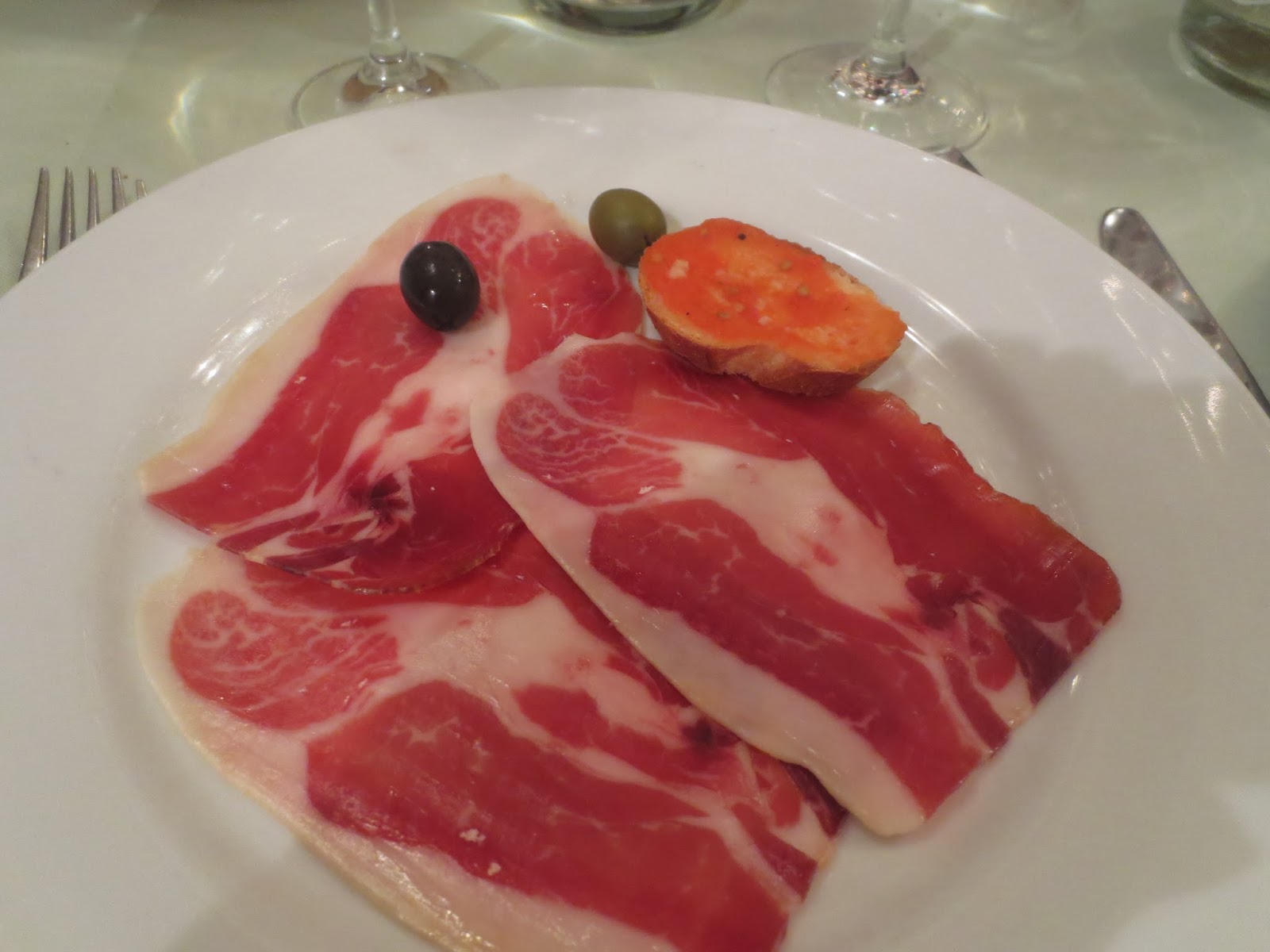
Top starters included pata negra ham, garlic prawns and lobster soup, all delicious. For the main course, the oven-baked Mistkratzerli or small chicken was served as two plates with matchstick chips. There was also a chicken stew and tender lamb, plus various topical fish and seafood options.


The restaurant is a very popular meeting point for groups and was very busy on this December lunchtime. Service was personal, although rather slow due to the number of customers. But the atmosphere was very convivial. To accompany our meal, there was Spanish wine by the glass, beer and water in carafes. And for dessert, the crema catalana was delicious.

For a special occasion this is a cosy and traditionally-styled venue, but be sure to book well ahead. Buen provecho!


Saturday, 30 November 2013

Restaurant of the Month November 2013

Restaurant Singapore, Badenerstrasse 530, 8048 Zurich
044 401 15 10

This restaurant has been a feature of Zurich Altstetten for many years, but no longer has a website and can therefore be tricky to track down. But take tram 2 to Freihofstrasse, just past Letzigrund, and you'll find this popular Asian eatery on the right hand side. There's a self-service place on the left but for our Dining Around the World November venue we booked a table in the waitress service room on the right.

The menu offers several tempting Singaporean-style dishes such as chicken and beef satay and a four-dish Reistafel, and we had our own Singaporean expert Penny to advise on a choice of food. Many of the dishes were marked as spicy, but there were also less spicy Malaysian and Chinese options, and all priced at a reasonable CHF23.50. I enjoyed the satays with peanut sauce, fruit and rice, a substantial dish with 6 skewers. Those in the know opted for a Poh Pien starter - a type of steamed spring roll - and shared a bowl of Laksa for the main course. This consisted of a pot of prawns, chicken pieces and tofu with rice noodles in a moderately spicy soup of coconut milk, cardamom and spices. Penny says that this is really a street dish in her native country.

Some of the other diners shared a selection for four people - Chicken Kung Po, Beef with Black Bean Sauce, a Malaysian Reistafel which comprised four different veggie dishes, and a wonderful lamb curry. There were also less spicy options available. Others opted for the dumplings as a starter. Everyone seemed happy with their adventurous choices.

The restaurant gets very busy at lunchtimes so it's good to reserve and it was quite crowded when we were there. You can also choose from a selection of cooling Asian beers to go perfectly with the spicy meal.

For an interesting lunch with attentive service and a varied menu, try the Singapore. Don't let the poor online access put you off - give them a call.

Friday, 1 November 2013

Restaurant of the Month October 2013

James Joyce Irish Pub - Pelikanstrasse 8, 8001 Zurich

http://www.jamesjoyce.ch/
An informal lunch in an Irish pub was enjoyed by 12 members of ZIWA's Dining Around the World group on the last Tuesday of October. The bar staff welcomed us warmly and had set aside a whole bay where we could chat and enjoy some typical pub grub. As well as two daily specials and a dessert choice, we could select from some of the classic dishes including Fish and Chips, the James Joyce complete hamburger and the Club Sandwich. All washed down with a glass or two of Irish draught Guinness.

The bar, located just off Zurich's famous Bahnhofstrasse, has a fascinating history. James Joyce, the renowned Dublin writer, spent many years in Zurich and indeed also died and was buried here. As the pub website tells us,


'The interior furnishing originates from the Jury's hotel in Dublin and was run there as the Antique Bar.

'At the beginning of the 1970s,  the hotel had to give way to urban development measures. At an auction a businessman from Zuerich purchased the interior furnishing and sold it to the SBG (now UBS) at that time. They had the far-sightedness and honoured a guest of many years' standing and friend of the Zuerich city (James Joyce) in this special way.

'The 19th century Art Nouveau bar is considered worldwide as one of the most beautiful bars, as it has been protected and preserved entirely.

'An Irish bar situated in Zuerich may therefore very well be called the James Joyce Bar.'  

The bar is a popular lunchtime venue for local bankers and businessmen, and it is usually advisable to book. Unlike most English pubs, at Zurich's James Joyce there is waiter service and an attractive menu which in October contained a nice selection of autumn specials as well as typical British and some Swiss dishes. The beer selection includes the famous black gold, the Guinness being served in small or large glasses. Having tasted the real stuff in Dublin only a week ago, I found the Swiss ale rather weak compared to the Irish brew. But still tasty. There is a wide choice of beers on draught and bottled as well as whiskies, and unlike most Irish bars, an extensive wine list.

The pub also opens in the evenings but food isn't served until 6pm and the atmosphere is a little more subdued then. However whatever the time of day or evening, you can be sure of a warm welcome with an enticing selection of Irish, British and international food and beverages. Cheers!

Tuesday, 1 October 2013

Avenches – a medieval town with a long Roman history

Friday 27 September 2013

http://www.avenches.ch/en/index.cfm

ZIWA’s Discovering Zürich and Switzerland group members are used to making long journeys to explore every corner of our beautiful country, but this trip had even more going for it than usual. A three-stage train ride into Canton Vaud, a challenging French lunch menu, two different eras of history and a French-speaking tour guide! Not to mention the chance to meet people from nine different countries and five continents. Where else but in ZIWA?

The journey and the all-important lunch

First we found our coach at the far end of the fast train to Geneva via Fribourg, only to find our seats taken by a party of noisy schoolboys. We closed ranks, and they got out at Bern so we could hear ourselves speak again then. Then in Fribourg there was a rush to catch the regional train to Payerne, and find new neighbours to chat to and more gossip to catch up on. Finally we caught another local train to the small but picturesque old town of Avenches, famous for its towering turrets and its Roman amphitheatre. After hiking uphill, pausing briefly to admire the view, we hurried to find our seats inside the historic Hotel Restaurant de la Couronne for lunch. The menu du jour kept us occupied for quite a while – vivaneau anyone? Choices were divided between that and the civet or venison with all the trimmings, including extra spätzli. Dessert was a yummy chocolate fig cake, and the wine card got a good testing too.

Friends, Romans, countrymen

After settling up and checking out all the facilities, we strolled out to find our guide near the famous Roman amphitheatre. A lovely lady, Sonia Müller, but she spoke only French. Multilingual Chip came to the rescue as translator, with several other members of the French conversation groups chipping in. We heard that the Helvetic tribes, the local Celtic people, were in dispute with the Alamanni, a German tribe, and were defeated here by Julius Caesar in 58BC on his way to conquer Gaul. The Romans under Augustus established a walled settlement known as Aventicum in 15BC, whose relics can be seen in and around the small town to this day. Aventicum became the capital of the Helvetii due to its strategic position and links to waterways. The local people gradually adopted the Roman way of life and benefited from its extensive empire and trade connections. The Sacred Way was built in the town centre in 71-72 AD, and the town boasted 20,000 inhabitants in its heyday. The old town wall is still visible with its 73 watchtowers and four gates. Stone from Neuchatel was brought via canal.

Burial relics

We then entered the Roman museum, which occupies an 11th century building extending over five floors, adjacent to the well-preserved Roman arena. We studied a map of the old Roman town, and saw several wall paintings, and relics and statues obtained from local burial sites. The museum also contained mosaics of gladiator combat with animals. Downstairs into the region of the dead, we learnt that while adults were cremated, children were buried in stone tombs along with funerary objects which have survived.  Constantine brought Christianity to the Roman Empire in 312 AD.  Upstairs on the first floor we saw many beautiful sculptures including the 2000 year old bust of Marcus Aurelius cast in gold, excavated as recently as 1939. The frescoes, mosaics and coins gave us a fuller picture of life in Avenches during the Roman settlement. On the top floor we saw models of the lifestyle of the local inhabitants, which improved under the Romans.
Back beside the amphitheatre, we heard that today it is used for staging opera, rock festivals and a tattoo in October: 16,000 people can be seated when extended.

Dark and Middle Ages

The imposing castle overlooking the town was home to 22 bishops, although barbarians destroyed part of the original settlement. In the 13th century, the Bishop of Lausanne founded a small house in Avenches, when window taxes were common. It was later enlarged in the Renaissance style in the 16th century, by the invading Bernese. Sculptures of the builder, mason and other key figures can be seen on the outer wall of the castle which also served as a prison. The site of an original drawbridge can still be seen; a modern theatre has also been built on the site.

We strolled around the outer wall of the medieval town and re-entered via the 14th century Tour de Vully at the Porte des Voleurs. On the inner wall, we noticed a Star of David, which indicated a place of sanctuary for Jews. The main street of the medieval town is still much the same, the Town Hall dating back to 1438, and the nearby Rue Paysan was where the people kept their animals and dried tobacco leaves on their sloping roofs.

We just had time to peep inside the curious wooden-roofed church of Mary Magdalene, formerly a Benedictine priory, which was rebuilt in 1709-11 after the Reformation. Then we said Au revoir to Sonia, our guide, and took a welcome drink outside before heading back to the station to catch the direct train to Bern. Another opportunity to socialise, share recipes and email addresses and to thank Anne-Marie for sharing another aspect of her beloved French-speaking part of Switzerland.

PS. Vivaneau turned out to be snapper.

Julia Newton, 1 October 2013.


Monday, 30 September 2013

Restaurant of the Month - September 2013

Restaurant Le Cedre, Hechtplatz, near Zurich Bellevue


On one of the last days of summer, it is possible to enjoy a delicious Lebanese buffet al fresco at the Bellevue branch of the well-known Zurich restaurant. Last week, 15 hungry ladies from the ZIWA Dining Around the World group converged on the terrace of the restaurant, although there was plenty of space indoors had it been cooler. We chose tap water or soft drinks to accompany the meal, and we all opted for the mezzeh option - a typical Mediterranean buffet. The waiter also suggested an accompaniment of tender shredded beef which had been marinaded the night before before baking. It was all delicious!


The food arrived on our table - pittas, stuffed flatbreads, dips such as hummus, baba ganouche (a smoky aubergine dip), mint and tomato salad, olives, falafel, filled pastries and stuffed vine leaves, and many more whose name we didn't know. Everyone was eager to share their favourites, and the dishes kept on being refilled. We identified aubergines, artichokes, chickpeas, cheeses, yogurt and many other vegetarian dishes as well as some samosas filled with minced meat. We kept our plates filled and the dishes kept on coming. It all tasted fresh and not at all spicy.


The mezzeh platter costs CHF25 per person, and the meat platter for four cost CHF30 each - we had four plates. We could have also tried the Lebanese wine but this time we concentrated on eating! Including drinks, we paid CHF40 per person, and left a nice tip. There are other options on the menu which were also good value for an individual meal. And for dessert they offer a sticky baclava or fresh fruit.

The parent branch of Le Cedre at Stauffacher is also popular and also hosts belly dancing evenings, but the Bellevue location was convenient for lunch and less crowded. Everyone was keen to repeat the occasion. Yummy!


Thursday, 5 September 2013

Discovering Appenzell and its colourful history


Wednesday 29 August, 2013

http://www.myswitzerland.com/en-ch/appenzell2.html

http://www.appenzell.info/en


One member came all the way from Melbourne to enjoy the rain
On one of the wettest days of the summer, 21 members of the ZIWA Discovering Zürich and Switzerland group travelled by train from Zürich via Gossau SG to the smallest cantonal capital of Switzerland’s smallest canton, Appenzell Innerrhoden. Heavy rain and our local guide Maria Inauen greeted us at the station. Umbrellas were the order of the day. The picturesque village of Appenzell now has around 5.500 inhabitants, and the canton has a mere 15,000 inhabitants living in an area of 172 square kilometres. The canton is divided into mountains, forest and farmland, and agriculture, tourism and handicrafts support the local economy. As we dodged the rain under a canopy of umbrellas, we learnt more about this historic town and its traditions. Some people had to seek out sensible shoes before they could relax and enjoy the tour.

Appenzell’s history and tradition

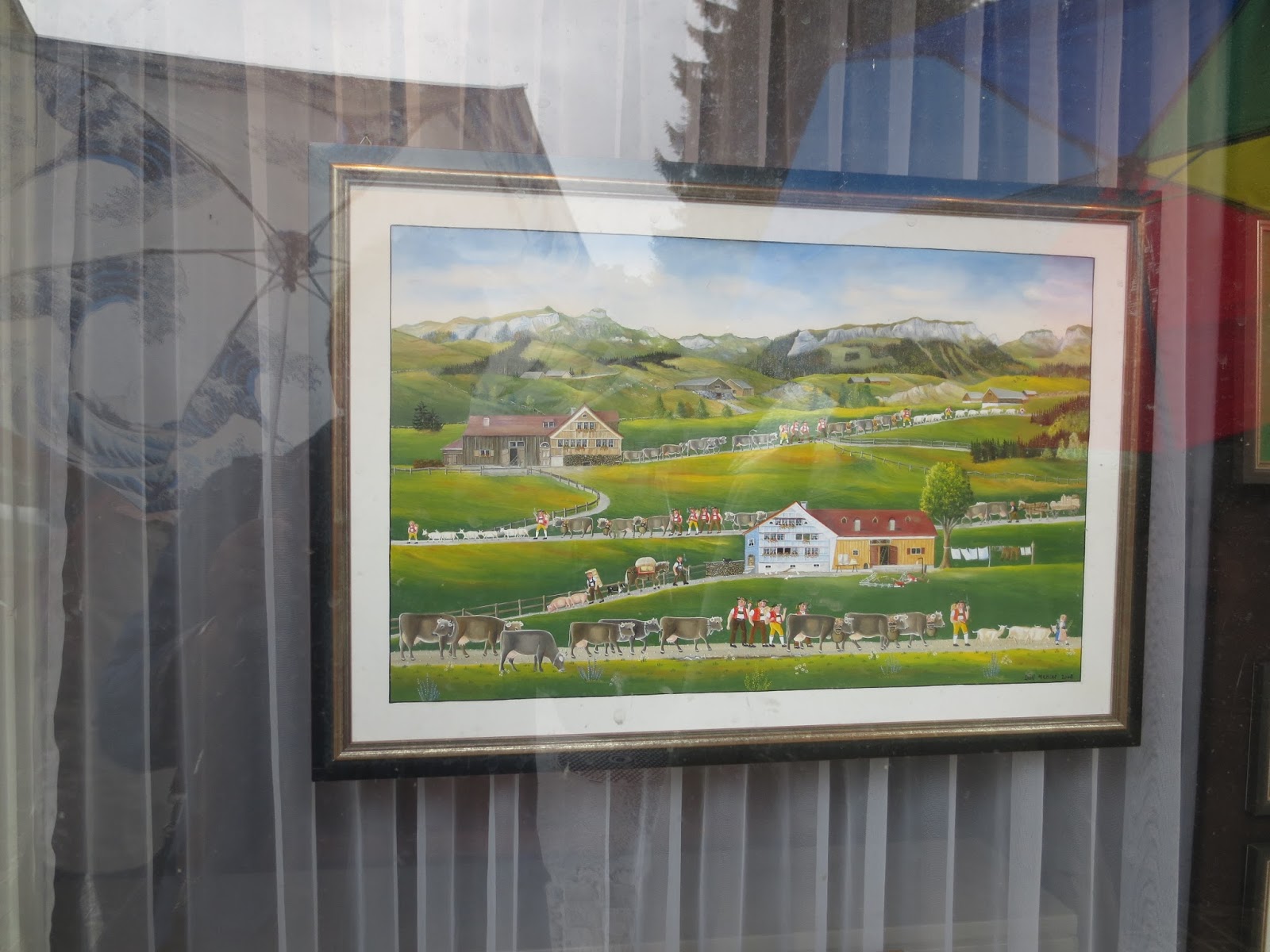
Paintings of local traditions are on sale in the local shops
The canton of Appenzell became independent from St. Gallen and was accepted into the Swiss confederation in 1513, and this year is celebrating its 500th anniversary. In 1560, a fire destroyed 170 wooden houses in the small town, and one person lost his life. Appenzell village was Catholic, but the Protestant canton of Zürich gave gold to help the recovery. In 1597, the canton divided into two half-cantons along religious lines, with Innerhoden (IR) being Catholic and Ausserrhoden (AR) Protestant. People were given the choice of where to settle but a strict divide was maintained. There are four nunneries in Innerrhoden, and today we stood outside one of them which had sadly closed its doors when the sisters of the Franciscan order were reduced in number to five. Pilgrims on the way to Santiago de Compostelo can still stay in the Appenzeller convent though.

Next door in the Postplatz was a castle, or what goes for such in Switzerland, a once elegant family home built for the Löw family in 1563, with a turreted roof and an extensive garden. However the current owners, the Sutter family, have no children so its future is insecure. Across the road we saw one of many arts and crafts shops, this one selling works by local artist Mettler, who painted scenes of cows and the alpine parades. The festival of bringing the cows down from the high pasture at the end of summer, from mid-August to mid-September, is one of the most famous and colourful, something to see once at least during one’s stay in Switzerland. Several processions take place with a similar format with a leader, a man dressed in tight yellow trousers, the three cows bearing large heavy bells, and the white goats. The landscape of the Alpstein Mountains is a popular destination for hikers, and would be even lovelier on a dry day.

Life in Appenzell

The interior of the Catholic Church of St. Mauritius is ornate
Appenzell is famous for its cheese, and opposite the art shop we saw a yellow house which is the headquarters of the cheese producers. Beer is another famous local product, and we glimpsed the Quöllfrisch brewery near the fast-flowing River Sitter. The artist Dörig makes bells for the cows and also personal jewellery items; men’s single earrings are especially popular in Appenzell apparently.  It’s true that many local farmers are on the lookout for a prospective marital partner.

The tower of the Catholic Church survived the fire of 1560, and we noted the 1920 portrait of St. Moritz on the tower exterior; it caused some controversy at the time due to the saint’s bare legs. We took shelter in the church crypt, to learn more about the traditional costumes that are worn for the local parades and are often handed down – our guide Maria had a dress and headgear from her grandmother. Men wear red jackets and women have colourful skirts and headpieces which can take 360 hours to make. The colour of lace on the hat determines whether the wearer is single or married. Baptisms and meditation take place in the church crypt. Outside we viewed the cemetery which appeared to be very full; nowadays cremated relics are also scattered here on a smaller plot. The church interior is now very ornate, in the Baroque style seen in Einsiedeln, and we learnt that it originated in 1320, was rebuilt in 1488-1515, and was renovated again in 1823-28. Stained glass windows were given by donors. The high altar is not centrally located due to the hardness of the underlying Alpstein rock.
The pharmacy is suitably illustrated with herbs

Appenzell’s politics

Up the main street or Hauptgasse, we passed the brick-red 16th century Rathaus with its colourful flags, and noted the position of the Museum Appenzell on the floor above the adjacent tourist office, with its distinctive hanging sign. The building also contains original prison cells from the olden days. The buildings all along the Hauptgasse had been recently repainted on their facades in differing styles, by Johannes Hugentobler, who married the pharmacy owner’s daughter. We saw murals of flowers, geometric shapes and symbols as well as 35 different medicinal herbs.

At the top of the main street we reached the Landsgemeindeplatz where voting is conducted outdoors on the last Sunday in April. Elections are held for the local government, the high court officials and the representative to the Ständerat. 5000 people traditionally attend these occasions which are also popular with tourists. Voting is done by a show of hands unless it appears to be a close call, in which case there are two exits where voters are counted out. Men carry swords in the parade from the Town Hall to the main square; it was only in 1991 that women in Appenzell got the vote. Our resident guide hoped for a better future from now on!

After the informative tour, a lovely lunch was taken at the traditional Café-Hotel Appenzell before visiting the Museum Appenzell with its artefacts and photos of local history and the Liner Museum, which features traditional and contemporary artwork.

Julia Newton, 5 September 2013.


Monday, 2 September 2013

Restaurant of the Month - August 2013

Restaurant Seerose, Seestrasse 493, 8038 Zurich-Wollishofen


While the summer weather is still warm and sunny, it's wonderful to eat lunch beside the beautiful lake of Zurich. At the end of the month, it was rather cool to sit outside, but the Seerose has an open indoor dining area very close to the water's edge. Our waitress was friendly and helpful, and we perused the menus for special lunch options and the a la carte choices. One of the quirks of this upmarket place is the handwritten day's specials, which are rather challenging to read. But we could choose from two starter and two main course options at a reasonable price of CHF 31.50: spicy cauliflower soup or beef tartare bruschetta, followed by prawns with potatoes and morels or lamb escalopes with tagliatelli and a delicious sauce. Someone in our friendly ZIWA Dining Around the World group also opted for the 'anti-ageing menu' of salmon and summer vegetables which looked delicious as well as healthy.

For wine enthusiasts it was possible to try out a choice of two whites - a Gruner Veltliner and a Pinot Grigio - before opting for one, in this case the Italian wine. A red Rioja complemented the lamb nicely, and there was also a choice of beers. The waitress replenished our water carafes frequently, and almost forgot to divide the cost between us when the time came to pay. CHF33 between ten people did seem rather pricey for a couple of glasses of sparkling water each. But the service and food were excellent.


The Seerose is twinned with the Restaurant Chez Fritz in Kilchberg, and both of them are beautiful places to dine right beside the lake on a special occasion. The international dinner options will cost you CHF 50-60 so you may prefer to try the daily lunch specials first, before making your reservation for a special occasion. Italian, French and Asian dishes are featured on the menu. Wine is available by the glass at around CHF 10-11 or you could splash out on a bottle. Why not?

For a delicious and rather special meal right beside the Zurichsee, take the 161 or 165 bus from Burkliplatz to Seerose, or try your luck with the restaurant parking or the spaces along the Seestrasse. It's definitely worth the effort!